
Islington-City Centre West is one of those Etobicoke neighborhoods that most GTA residents have passed through without fully understanding what makes it distinctive. The Islington subway station is a familiar transit node for thousands of daily commuters. The commercial strip along Bloor Street West is a blur through the window on the TTC. But for the residents who have chosen this community as home — and for prospective buyers and renters evaluating whether it fits their next chapter — Islington represents something genuinely compelling: one of the few neighborhoods in Etobicoke that delivers true urban walkability, direct subway access, and a village commercial character simultaneously. This guide covers every dimension of life in Islington-City Centre West — from the subway and GO Transit connectivity that defines the area’s transit advantage to the condo and rental market, the schools, the restaurants, and the honest trade-offs that come with choosing an address here. For the broader context of moving to Etobicoke, this guide situated Islington within the full district geography so you understand what this specific neighborhood delivers relative to every other option in Etobicoke.
Where Islington-City Centre West Is and What Defines It
Islington-City Centre West occupies central Etobicoke along the Bloor-Danforth subway corridor, roughly bounded by the Mimico Creek to the west, Burnhamthorpe Road to the north, the Humber River to the east, and Bloor Street West running through the heart of the community. The neighborhood’s identity is inseparable from the Islington subway station — the intersection of the Bloor-Danforth Line and the dense commercial strip that has grown up around it over the past five decades.
The area is fundamentally urban in character — mid-rise and high-rise residential buildings, commercial storefronts on every ground floor along Bloor Street, pedestrian sidewalk volume that most Etobicoke neighborhoods never see, and a transit orientation where the subway rather than the car is the default mode of movement for a significant portion of residents. This urban density distinguishes Islington from the single-family residential neighborhoods that define most of South and Central Etobicoke, and it is what draws the specific demographic that consistently chooses Islington — urban professionals, transit-dependent households, and buyers or renters who prioritize walkability and commercial vibrancy over lot size and residential quiet.
For context within Etobicoke’s broader geography, the best neighborhoods in Etobicoke guide positions Islington among the district’s most transit-advantaged communities alongside Mimico’s GO corridor — each delivering a different version of transit-oriented urbanism that appeals to overlapping but distinct lifestyle preferences.
The Islington Subway Station: Central Toronto Access That Defines the Neighborhood
The Islington subway station is the single most defining feature of the Islington-City Centre West neighborhood — the physical and lifestyle anchor around which everything else revolves. For residents of this community, the subway is not just nearby, it is the structural advantage that makes Islington work as an address.
Travel times from Islington station:
- Union Station: Approximately 25–30 minutes via Line 2 to Yonge-Bloor and Line 1 southbound
- Financial District / King Station: Approximately 27–32 minutes
- Yonge-Bloor interchange: Approximately 15 minutes — the junction point for accessing the full Toronto subway network
- Kipling Station (westbound terminus): 5 minutes
- Bay Street corridor: Approximately 25–30 minutes depending on final destination
The Islington station functions as a major transit hub serving not just the subway but also as a terminus point for multiple bus routes extending north into central Etobicoke residential communities. For residents living within the immediate 5–10 minute walk radius of the station, car-free urban living is genuinely viable in a way that is structurally impossible in most Etobicoke neighborhoods.
The station also provides the connection point to MiWay (Mississauga Transit) at the bus terminal immediately adjacent — a practical advantage for residents whose employment or daily destinations sit in Mississauga rather than Toronto proper. For the comparison of living costs and lifestyle between the two municipalities, the Etobicoke cost of living 2026 guide provides the complete financial picture.
Islington GO Station: Commuter Rail That Most Islington Residents Do Not Use
For all the neighborhood advantages that Islington offers, it is worth clarifying one source of consistent confusion: there is no Islington GO Station within the Islington-City Centre West neighborhood. The nearest GO Train access is the Kipling GO Station approximately 2.5 kilometers west along Bloor Street, accessible by TTC subway in 5 minutes. For residents who live along Bloor Street West between Islington and Kipling, the GO Train is a practical option for Union Station commutes, but it is not a defining feature of the Islington neighborhood experience in the way the subway is.
The Mimico GO Station on the Lakeshore West line is approximately 3 kilometers south in South Etobicoke and provides a 15-minute direct rail connection to Union Station for those who can access it via bus or car — but for most Islington residents, the subway remains the primary and most convenient downtown commute method.
Condos in Islington: The Housing Stock That Defines the Neighborhood
The housing stock of Islington-City Centre West is dominated by mid-rise and high-rise condominium and rental apartment buildings constructed primarily between the 1970s and the present day. This is fundamentally a condo and apartment neighborhood rather than a detached-home community — and understanding that reality before choosing an Islington address is essential to managing expectations.
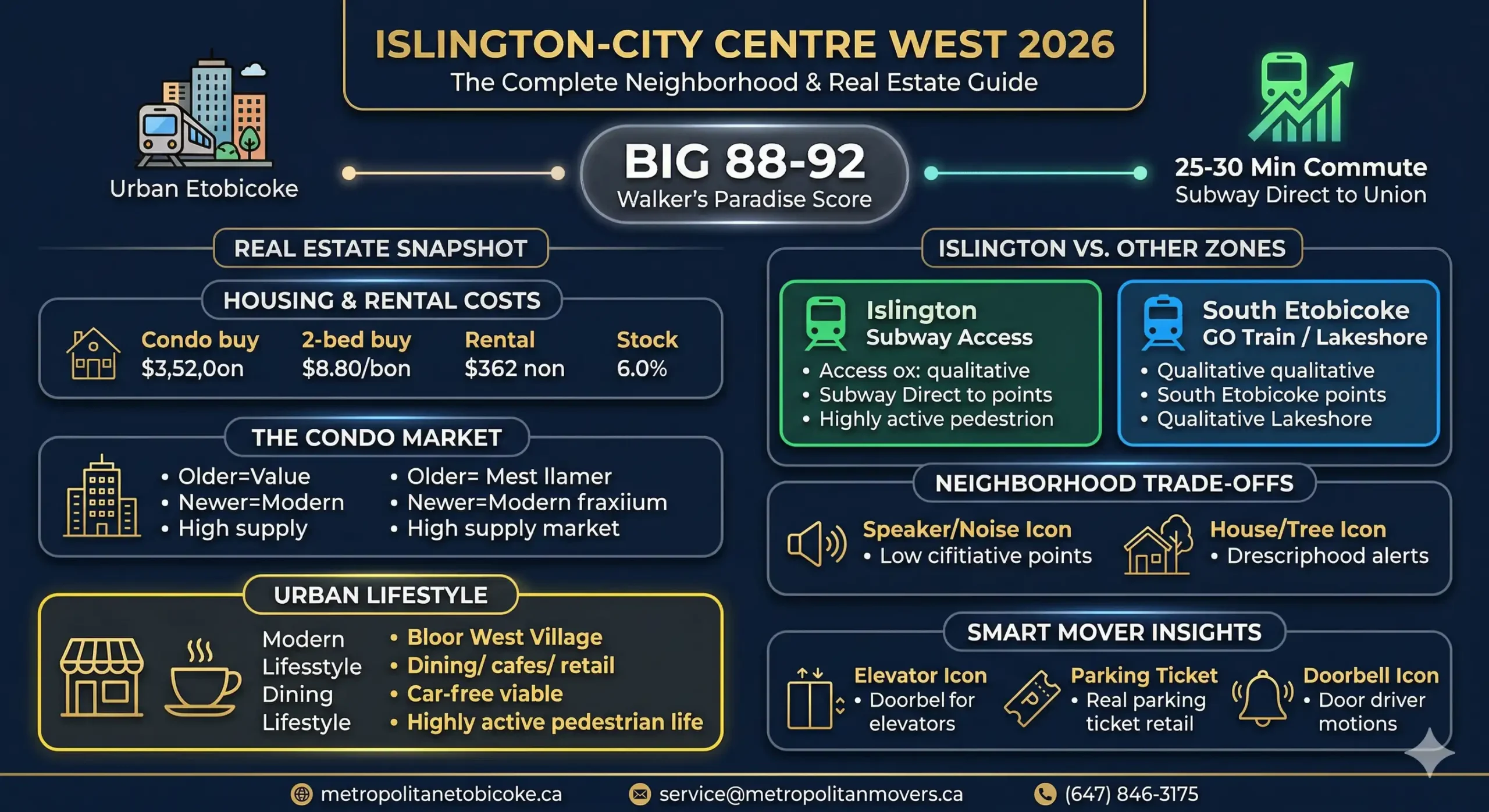
Condo market profile in 2026: The Islington condo market includes a wide range of vintages and price points. Older buildings from the 1970s and 1980s along Bloor Street West and the residential streets immediately north and south offer one-bedroom units in the $450,000–$600,000 range depending on building condition, amenities, and specific unit finishes. These buildings typically feature larger unit sizes than contemporary construction — one-bedroom units with legitimate dining areas and usable balconies — but older kitchens, bathrooms, and building systems that reflect their age.
Newer condo buildings constructed in the 2000s and 2010s command premiums for modern finishes and building amenities. One-bedroom units in these buildings range from approximately $550,000–$700,000, with two-bedroom units from approximately $700,000–$900,000.
The rental market in Islington: For tenants, the Islington rental market offers one-bedroom apartments averaging approximately $2,200–$2,600 per month depending on building age and amenities. The older purpose-built rental stock — much of it dating from the 1970s — provides better square-footage-per-dollar value than newer condo rentals, and many older buildings include heat and water in the monthly rent, reducing total carrying costs relative to newer condos where all utilities are separately metered.
The rental supply in Islington is substantial relative to most Etobicoke neighborhoods — the combination of older purpose-built rental towers and a significant volume of investor-owned condo units creates availability across a meaningful price range. The Etobicoke rent prices analysis situates Islington within the district’s broader rental landscape.
Living in Islington: The Urban Lifestyle That This Neighborhood Delivers
Living in Islington-City Centre West means accepting and embracing an urban density that is genuinely different from the residential suburban character that defines most of Etobicoke. The neighborhood operates at a pedestrian volume, commercial activity level, and transit orientation that is closer to downtown Toronto neighborhoods than to The Kingsway, Alderwood, or the residential pockets of North Etobicoke.
What daily life looks like in Islington:
Morning routines revolve around the subway. Residents walk to Islington station — 5 minutes from most addresses in the immediate catchment — board eastbound trains, and are at Yonge-Bloor or Union Station within the commute window that makes car-free professional life viable. Coffee shops along Bloor Street West open early to serve this commuter flow, and the pedestrian sidewalk energy from 7–9 AM reflects the density and transit orientation that defines the area.
Daytime and evening street life is anchored by the Bloor Street West commercial strip — the Islington Village BIA encompasses dozens of independent restaurants, cafes, service providers, and retail shops that create genuine walkable urbanism. Grocery needs are served by multiple options within walking distance, and the density of medical, dental, and professional service offices along Bloor means most routine errands are completed on foot rather than by car.
Weekends see less commuter volume but sustained local foot traffic — residents walking to brunch, browsing the independent retail along Bloor, accessing the Etobicoke Valley parks system along Mimico Creek to the west, or taking the subway to destinations across Toronto without the parking and driving friction that suburban life creates.
The honest trade-off is noise, density, and the absence of the residential quiet that characterizes Etobicoke’s single-family neighborhoods. Islington is not the place for large lots, backyard privacy, or streets where children play hockey without car interruption. But for urban professionals, couples, and individuals who value walkability and transit access above residential space, it is one of the strongest lifestyle propositions available in the entire district.
Islington Walk Score: How Walkable Is This Neighborhood Actually
Islington-City Centre West achieves a walk score of approximately 88–92 out of 100 in the immediate blocks surrounding Islington station — classified as a “Walker’s Paradise” where daily errands do not require a car. This places Islington among the top three most walkable neighborhoods in all of Etobicoke alongside Mimico and the Long Branch waterfront corridor.
What the walk score reflects in practical terms:
Within a 5-minute walk of Islington station, residents can access:
- Multiple grocery options including national chains and independent markets
- Banking and financial services
- Medical and dental offices
- Pharmacies and personal care retailers
- Restaurants spanning a wide range of cuisines and price points
- Coffee shops, bakeries, and casual dining
- Transit connections to the full TTC network and MiWay service to Mississauga
Within a 10-minute walk:
- Mimico Creek trail system connecting to the broader Etobicoke Valley parkland network
- Library services at the Richview branch
- Community centres and recreational programming
- Additional retail and service providers along Dundas Street West to the south
The walkability advantage that Islington provides is one of the most significant lifestyle differentiators for households choosing between this neighborhood and the car-dependent communities that make up most of Etobicoke’s geography. For buyers and renters conducting a South Etobicoke vs North Etobicoke cost comparison alongside the Islington evaluation, the walkability factor is one of the clearest dividing lines — Islington and South Etobicoke’s waterfront neighborhoods deliver genuine urban walkability, while North Etobicoke and much of Central Etobicoke do not.
Schools Serving the Islington Neighborhood
For families with school-age children considering Islington, the neighborhood is served by both the Toronto District School Board and the Toronto Catholic District School Board, with several elementary and secondary options within the immediate catchment or short transit distance.
Public elementary schools: Islington Junior Middle School (TDSB) serves JK through Grade 8 and is positioned directly within the Islington catchment on Cordova Avenue just south of Bloor Street. The school provides French Immersion programming alongside standard English-stream classes and participates in TDSB’s Arts Focus program — a significant draw for families prioritizing creative education.
Bloordale Middle School, Kingsway Junior School, and other TDSB schools serve portions of the broader Islington catchment depending on specific address boundaries. The TDSB’s school finder tool at tdsb.on.ca allows families to confirm the exact catchment school for any address under consideration.
Catholic elementary schools: St. Bernadette Catholic School (TCDSB) serves the Islington area for families seeking Catholic elementary education. Several additional TCDSB schools operate within short distance for families whose specific addresses fall into adjacent catchments.
Secondary schools: Martingrove Collegiate Institute (TDSB) is the primary secondary school serving much of the Islington area, offering academic, applied, and open-level courses alongside specialized programs including French Immersion continuation from elementary, Arts programs, and co-operative education. Etobicoke Collegiate Institute and other TDSB secondary schools also serve portions of the catchment.
The realistic assessment for families: Islington is not typically chosen by families primarily for school access — The Kingsway, Edenbridge, and the South Etobicoke residential neighborhoods deliver stronger school options alongside larger homes better suited to families with children. However, for families who prioritize walkability, transit access, and urban living above suburban space, the schools serving Islington are entirely adequate and the lifestyle trade-offs are ones that many urban families embrace deliberately rather than accept reluctantly.
For the comprehensive analysis of family-friendly neighborhoods in Etobicoke, that guide positions Islington within the full district family lifestyle spectrum.
Islington Restaurants and the Bloor Street West Dining Scene
The restaurant and dining scene along Bloor Street West in Islington Village is one of the neighborhood’s most consistently cited lifestyle advantages — a genuine independent dining corridor that creates the kind of neighborhood commercial character that most suburban communities struggle to sustain.
The cuisine range spans multiple continents and price points:
Independent restaurants along Bloor Street West between Royal York Road and Kipling Avenue offer Caribbean, South Asian, Middle Eastern, Italian, Mexican, Thai, Japanese, and contemporary Canadian cuisine. The concentration of independent operators rather than franchise chains creates a dining scene with genuine character and neighborhood loyalty that franchise-dominated strips lack entirely.
Several Islington restaurants have built reputations that draw diners from across the west end. The independent cafe culture along Bloor supports morning coffee routines, afternoon work-from-cafe setups, and weekend brunch traditions that give the neighborhood its daily rhythm.
The accessibility of this dining scene via subway — both for Islington residents who walk to dinner and for visitors arriving from across the TTC network — creates a vibrancy that isolated suburban restaurant strips cannot replicate. The pedestrian volume along Bloor Street during evening and weekend dining hours confirms what the walkability data suggests: Islington operates as a genuine urban village within a district where that category is rare.
Grocery and food retail: Beyond restaurants, Islington provides walkable access to multiple grocery options spanning national chains and independent ethnic markets. Residents consistently cite the ability to complete all grocery, pharmacy, and routine retail needs on foot as one of the most underappreciated advantages of the neighborhood — an advantage that is structurally impossible in the car-dependent suburban pockets that define most of Etobicoke.
Commuting from Islington: Transit, Driving, and Getting Around
The commute equation from Islington is what defines the neighborhood’s appeal for the specific demographic that chooses it — transit commuters who value direct subway access above all other residential factors.
For subway commuters to downtown Toronto: Islington is one of the strongest transit-based commute addresses available anywhere in Etobicoke. The 25–30 minute subway commute to Union Station, the 15-minute connection to the Yonge-Bloor interchange, and the seamless integration into the TTC network create a commute experience that eliminates the GO Train transfer, the parking search, and the highway congestion that characterizes most GTA suburban commutes.
For drivers: Highway access from Islington is functional but not exceptional. The Gardiner Expressway and Highway 427 are accessible within approximately 10 minutes via arterial roads, and Highway 401 is approximately 15 minutes north via Islington Avenue or Kipling Avenue. For residents whose employment requires driving to suburban office parks or industrial areas not served by transit, Islington’s transit advantage is less relevant and the neighborhood’s parking challenges — many older condo buildings have limited parking ratios — become a meaningful drawback.
For cyclists: Bloor Street West through Islington includes bike lanes that connect to the broader Toronto cycling network. For recreational cycling, the Mimico Creek trail system immediately west of the neighborhood provides off-road trail access into the Etobicoke Valley parkland network. For urban cyclists commuting east along Bloor or accessing the broader trail network, Islington provides better connectivity than most Etobicoke neighborhoods.
The Islington Village BIA: Community Identity and Commercial Vitality
The Islington Village Business Improvement Area anchors the commercial identity of the neighborhood and provides the organizational structure that sustains the independent retail and dining scene along Bloor Street West. The BIA organizes community events, coordinates streetscape improvements, and advocates for the independent businesses that give Islington its character.
The existence of an active BIA signals something important about a neighborhood — it indicates sufficient pedestrian density, commercial vibrancy, and community investment to sustain the organizational infrastructure that walkable urban villages require. Suburban arterial strips rarely achieve this critical mass. The Islington Village BIA confirms what the walk score data suggests — this is one of the few addresses in Etobicoke where genuine urban village character exists rather than being aspirational marketing language.
What Islington Does Not Provide: The Honest Trade-Offs
Understanding what Islington-City Centre West does not deliver is as important as understanding its strengths — because the neighborhood is genuinely excellent for a specific lifestyle and a poor fit for households whose priorities differ.
Islington does not provide large residential spaces. The housing stock is dominated by one-bedroom and two-bedroom condos and apartments. Families needing three bedrooms, dedicated home offices, or usable outdoor space will find Islington constraining in ways that detached-home neighborhoods are not.
Islington does not provide residential quiet. The density, commercial activity, and transit orientation create ambient noise and street activity that is the opposite of suburban tranquility. For households who value the peace of a residential cul-de-sac, Islington will feel relentlessly urban in ways that are exhausting rather than energizing.
Islington does not provide the prestige address identity that neighborhoods like The Kingsway or the Mimico waterfront condos carry. It is a working, functional urban neighborhood that delivers tremendous practical value for transit commuters — but it does not deliver the aspirational lifestyle brand that some buyers and renters seek from their address.
Islington does not provide abundant green space within the immediate neighborhood. The Mimico Creek trail system is accessible, but the neighborhood itself is hard urban rather than park-adjacent. For families who prioritize immediate backyard or park access for children, South Etobicoke’s residential neighborhoods or the conservation-adjacent communities provide better fits.
For buyers and renters weighing these trade-offs alongside Islington’s advantages, the is Etobicoke safer than downtown Toronto analysis provides the safety context that is relevant for urban-density neighborhoods across the district.
Who Islington-City Centre West Is Best Suited For in 2026
Based on everything this neighborhood offers — and everything it does not — Islington makes the strongest case as a residential destination for:
- Transit commuters to downtown Toronto who work at Union Station or anywhere accessible from the subway and want to eliminate the GO Train parking search, the Highway 401 congestion, and the unpredictability of driving commutes
- Urban professionals and couples who prioritize walkability, dining access, and the energy of pedestrian street life over residential space and backyard privacy
- Car-free or car-light households who view vehicle ownership as an expensive burden rather than a necessity and want a neighborhood where life genuinely functions without one
- Renters seeking value within Toronto’s subway network who recognize that Islington delivers comparable transit access to many downtown neighborhoods at rent levels $300–$500 per month below equivalent downtown addresses
- Buyers seeking Etobicoke addresses with urban character who want to be in Etobicoke for its overall advantages — safety, diversity, parks access — while maintaining the walkable urbanism that most of the district does not provide
Islington is less well-suited for families with multiple children who need space, buyers seeking prestige addresses or waterfront views, or households whose daily routines are car-dependent and whose employment destinations are not transit-accessible.
| Feature | Islington-City Centre West | Humber Bay Shores | The Kingsway | North Etobicoke |
|---|---|---|---|---|
| Transit Access | Excellent — Subway direct | Excellent — Mimico GO 15 min to Union | Limited — Bus to subway | Moderate — Bus dependent |
| Walk Score | 88–92 (Walker’s Paradise) | 75–82 (Very Walkable) | 50–65 (Somewhat Walkable) | 40–55 (Car-Dependent) |
| Avg. 1-Bed Condo Price | ~$500,000–$650,000 | ~$550,000–$750,000 | N/A — Limited condo supply | ~$400,000–$550,000 |
| Avg. 1-Bed Rent | ~$2,200–$2,600 | ~$2,400–$2,800 | ~$2,400–$2,900 | ~$1,700–$2,100 |
| Housing Type | Mid/high-rise condos, apartments | High-rise condo towers | Detached homes, estate properties | Mix — detached, apartments |
| Character | Urban village, commercial corridor | Waterfront condo community | Prestigious residential, tree-lined | Suburban affordable |
| Best For | Transit commuters, urban lifestyle | Waterfront lovers, commuters | Established families, prestige | Budget-conscious, space seekers |
Moving to Islington: Practical Logistics for Condo and Apartment Moves
Moving into an Islington condo or apartment involves specific logistics that differ from moving into a detached house in suburban Etobicoke. Understanding these requirements before moving day prevents the delays and frustrations that unprepared movers consistently encounter.
Elevator booking requirements: The majority of mid-rise and high-rise buildings in Islington require advance elevator booking for moves. Buildings assign specific time windows — typically 2–4 hour blocks — and violations of these protocols can result in building management refusing access to movers. Elevator booking must typically be confirmed 7–14 days before moving day, and weekend slots are the first to fill. For tenants and buyers on time-compressed schedules, coordinating the elevator booking before finalizing the move date is essential.
Parking and loading access: Many buildings along Bloor Street West and the residential streets immediately north and south have limited or no on-street parking adjacent to building entrances. Moving truck parking often requires temporary parking permits from the City of Toronto or coordination with building management to access service lanes or loading bays. Metropolitan Movers Etobicoke, with over 15 years of experience managing residential moves throughout the district, handles these logistics as standard practice for every Islington move.
Service entrance protocols: Most Islington buildings require movers to use designated service entrances rather than main lobby entrances. Advance confirmation of service entrance location, access procedures, and any building-specific requirements eliminates the confusion that first-time Islington movers consistently experience.
For comprehensive guidance on the full moving process, the guides to how to save money when moving and how much does long-distance moving cost provide the financial context alongside the logistics.
Frequently Asked Questions
Is Islington-City Centre West a good neighborhood to live in?
Yes — for the right demographic. Islington-City Centre West is one of Etobicoke’s most walkable and transit-connected neighborhoods, achieving a walk score of 88–92 and providing direct subway access to downtown Toronto in 25–30 minutes. It is best suited for transit commuters, urban professionals, and households who prioritize walkability over residential space. Families needing large homes and quiet residential streets will find better fits in South or Central Etobicoke’s detached-home neighborhoods.
How long is the commute from Islington to downtown Toronto?
The commute from Islington subway station to Union Station is approximately 25–30 minutes via Line 2 eastbound to Yonge-Bloor and Line 1 southbound. To the Financial District and Bay Street corridor, travel time is typically 27–32 minutes. The Yonge-Bloor interchange is approximately 15 minutes from Islington, providing access to the full TTC network for destinations across Toronto.
Are there condos for sale in Islington?
Yes — Islington-City Centre West is dominated by mid-rise and high-rise condo and apartment buildings. One-bedroom condos range from approximately $450,000–$700,000 depending on building age and condition, with two-bedroom units from approximately $700,000–$900,000. Older buildings from the 1970s and 1980s provide better space-per-dollar value than newer construction, though finishes reflect their age.
What is the walk score in Islington?
Islington-City Centre West achieves a walk score of approximately 88–92 in the immediate blocks surrounding Islington subway station — classified as a Walker’s Paradise where daily errands do not require a car. This places Islington among the top three most walkable neighborhoods in all of Etobicoke alongside Mimico and Long Branch.
How does Metropolitan Movers Etobicoke support moves into Islington condos?
Metropolitan Movers Etobicoke, with over 15 years of experience, provides residential moving services for all Islington condo and apartment buildings, handling elevator booking coordination, service entrance access, parking permits, and building-specific protocols. The team also offers packing services, storage solutions, and last-minute moving support for time-sensitive lease or closing dates.
Islington-City Centre West Delivers Urban Etobicoke Living at Its Best — and Metropolitan Movers Etobicoke Is Ready to Get You Moved In Without a Single Unnecessary Complication
Islington-City Centre West is not for everyone — and that specificity is exactly what makes it exceptional for the households it serves. This is a neighborhood where the subway is a 5-minute walk, where grocery shopping happens on foot, where car-free professional life is genuinely viable, and where the independent restaurants and commercial energy of Bloor Street West create the kind of walkable urban village that most of Etobicoke’s geography simply cannot replicate. The condo and apartment housing stock, the transit commute advantage, the 88–92 walk score, and the dining scene combine to produce one of the district’s most distinctive lifestyle propositions — one that appeals to urban professionals, transit commuters, and anyone who values connectivity and walkability above residential space and suburban quiet. When you have found your Islington address and are ready to make the move, Metropolitan Movers Etobicoke is here to handle every detail — from local moves within Etobicoke and furniture removals to long-distance relocations from Regina, Victoria, and beyond — with 15+ years of professional moving experience that ensures your first day in your new Islington home is the beginning of the urban Etobicoke life you moved here to create. Reach out today and make your Islington move completely seamless.