
Same city, completely different price tags. The South Etobicoke vs North Etobicoke cost gap surprises most newcomers who assume “Etobicoke” means one uniform market. Waterfront condos in Mimico command Toronto-level premiums while Rexdale townhouses offer genuine affordability just 15 minutes north. Choosing the wrong area means either overspending by thousands annually or missing lifestyle amenities your family needs.
Metropolitan Etobicoke relocates families between these neighbourhoods weekly. We watch people stretch budgets for lakefront views they rarely enjoy and others discover hidden value in northern communities. This guide breaks down real South Etobicoke vs North Etobicoke cost differences across rent, housing, taxes, commuting, and daily expenses so you choose wisely. For the complete Etobicoke financial picture, our Etobicoke cost of living 2026 guide covers every expense category.
Rent Comparison: Where Your Housing Dollar Goes Further
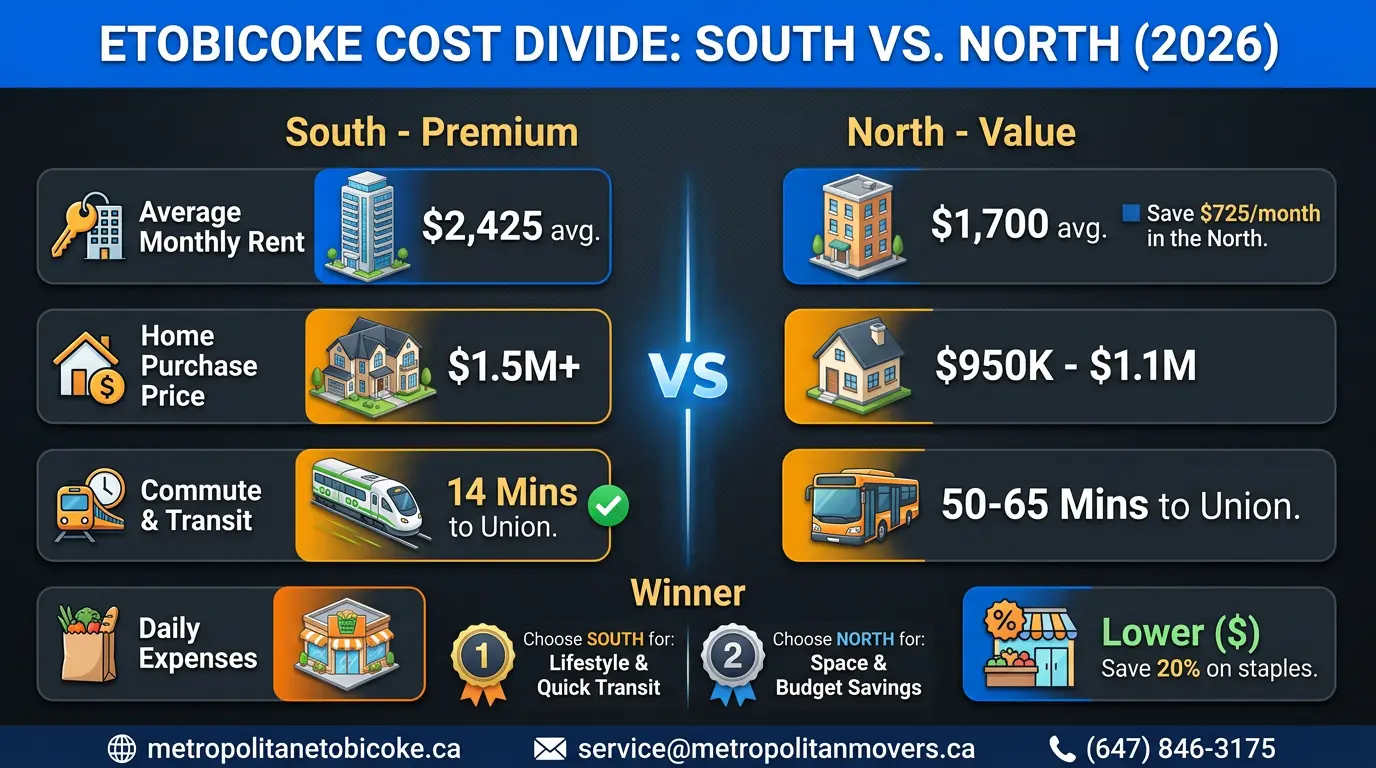
The South Etobicoke vs North Etobicoke cost divide starts with rent. Waterfront neighbourhoods like Mimico, Humber Bay, and New Toronto attract young professionals willing to pay premium prices for lake views and GO Transit access. Northern areas including Rexdale, Thistletown, and Smithfield offer significantly lower rents with more space.
The difference is stark. A family choosing Thistletown over Humber Bay saves $1,100 monthly on a two-bedroom — that is $13,200 annually toward savings, childcare, or eventually a down payment. Our most affordable neighbourhood in Etobicoke guide ranks every area by value.
Home Prices and Property Tax Reality
Buyers face even larger South Etobicoke vs North Etobicoke cost gaps. Mimico waterfront condos average $750,000-$900,000 while Rexdale townhouses start around $650,000 for comparable square footage. Detached homes in South Etobicoke routinely exceed $1.5 million; North Etobicoke detached properties trade between $900,000-$1.1 million.
Property taxes follow Toronto’s uniform rate of approximately 0.67% of assessed value, meaning higher-priced southern homes generate proportionally larger tax bills. A $900,000 Mimico condo costs roughly $6,030 annually in property taxes compared to $4,355 for a $650,000 Rexdale townhouse — a $1,675 annual difference on top of higher mortgage payments.
For newcomers exploring their options, our Etobicoke real estate for newcomers guide explains financing, neighbourhoods, and first-time buyer programs.
Commuting Costs: The Hidden Budget Factor
The South Etobicoke vs North Etobicoke cost calculation must include commuting. South Etobicoke wins decisively for downtown workers. Mimico GO Station reaches Union in 14 minutes. Long Branch and Mimico stations connect to the Lakeshore West line with trains every 15 minutes during rush hour. Monthly GO passes cost $387.75 for Zone 1.
North Etobicoke depends heavily on TTC buses connecting to Kipling or Islington subway stations. Rush hour commutes from Rexdale to downtown average 50-65 minutes. Car commuters face Highway 427 traffic plus downtown parking ($400-$600 monthly). Total monthly commuting costs from North Etobicoke run $450-$700 versus $388 from the south.
However, if you work in Mississauga, Brampton, or airport areas, North Etobicoke slashes commute times dramatically. Rexdale sits 10 minutes from Pearson compared to 35 minutes from Mimico.
Grocery and Lifestyle Expenses Across Etobicoke
Daily living costs show smaller South Etobicoke vs North Etobicoke cost variations, but they accumulate. South Etobicoke grocery options include Metro, Loblaws, and upscale independents with higher price points. North Etobicoke offers No Frills, FreshCo, and diverse ethnic supermarkets where staples cost 15-25% less.
Restaurant prices reflect neighbourhood demographics. Mimico brunch spots charge $18-$25 per plate while Rexdale offers comparable meals for $12-$16. South Etobicoke gyms average $60-$80 monthly; North Etobicoke fitness centres run $30-$45. Even haircuts differ — $45 in Humber Bay versus $25 in Thistletown for similar services.
Families comparing areas should review our family-friendly neighbourhoods in Etobicoke guide covering schools, parks, and childcare costs alongside housing.
Which Area Actually Fits Your Budget?
The South Etobicoke vs North Etobicoke cost decision depends on your priorities and income. South Etobicoke makes sense if you work downtown and value GO Transit access, prioritize waterfront lifestyle and walkable neighbourhoods, have household income exceeding $150,000, or plan to leverage appreciation in premium markets.
North Etobicoke fits better when maximizing square footage matters most, your workplace is near Pearson Airport or the 400-series highways, you need housing costs under $2,200 monthly, or you are building savings toward future goals. The Queensway corridor offers middle-ground pricing with decent transit and suburban space.
Metropolitan Etobicoke handles relocations across all Etobicoke neighbourhoods. Whether you need local moving services between areas or are arriving via long-distance moving, we know every building and street.
Making Your Etobicoke Move
Understanding South Etobicoke vs North Etobicoke cost differences transforms your housing search from guesswork to strategy. Budget-conscious families gain an extra bedroom in the north. Career-focused professionals save commute hours in the south. Neither choice is wrong — only uninformed decisions cost money.
Use our Etobicoke cost of living 2026 guide to calculate your complete monthly expenses, then explore moving to Etobicoke for relocation logistics. For last-minute moves when the perfect unit appears suddenly, we offer 48-hour booking.
Your budget deserves a neighbourhood that matches your lifestyle. Choose with data, not assumptions.
Metropolitan Etobicoke — your Etobicoke moving experts since 2008.