
Choosing between south and north Etobicoke is not simply a matter of personal taste — it is a financial decision with measurable consequences that will shape your household budget for years. The South Etobicoke vs North Etobicoke cost comparison reveals two fundamentally different economic realities separated by a few kilometres and a single expressway. South Etobicoke — encompassing Mimico, Humber Bay Shores, Long Branch, New Toronto, and Alderwood — offers waterfront living, rapid gentrification, and premium pricing driven by lake access and transit-oriented development. North Etobicoke — spanning Rexdale, Thistletown, Clairville, West Humber, Humberwood, The Elms, and Smithfield — delivers genuine affordability, highway connectivity, and a suburban residential character rooted in the post-war housing stock of the 1950s and 1960s. This guide, prepared by the relocation team at Metropolitan Movers Etobicoke, breaks every major cost category down by zone so you can make a decision backed by actual numbers rather than assumptions.
Etobicoke stretches across Toronto’s entire western flank, and treating it as a single housing market is a mistake that costs people real money. The Gardiner Expressway and Queen Elizabeth Way corridor effectively cuts the former municipality in half, creating two distinct cost environments with different price floors, different transit profiles, and different lifestyle packages. Whether you are a single professional hunting for the best rental value, a growing family weighing school proximity against mortgage size, or an investor calculating long-term cash-flow potential, understanding how costs diverge between these two zones is the most important first step in your housing search. If you are already planning a move and want to understand what residential moving in Etobicoke actually involves, getting that clarity early will prevent budget surprises on moving day.
Defining the Geographic and Economic Divide
Before comparing any dollar figures, the geographic boundaries between these two zones need to be crystal clear. South and north Etobicoke are not vague marketing labels — they correspond to distinct real estate districts, different transit networks, and separate community identities that have been evolving independently for decades.
South Etobicoke: The Waterfront Zone
South Etobicoke is a fast-developing and sought-after residential community of more than 60,000 residents. It occupies the far southwest corner of Toronto, bordered on three sides by water — the Humber River to the east, Lake Ontario to the south, and the Etobicoke Creek to the west. Its northern boundary runs along the Gardiner Expressway and Queen Elizabeth Way. Five distinct communities make up the south: Long Branch, New Toronto, Mimico, Humber Bay Shores, and Alderwood.
The housing stock here ranges dramatically — from century-old character homes on narrow, tree-lined streets to brand-new glass high-rise condominiums clustered along the waterfront. Several large multi-tower condominium developments have been completed near the Humber River over the past decade, transforming the skyline and population density of the south. The zone is defined by its lake access, its GO Transit stations at Mimico and Long Branch, and an ongoing wave of master-planned development that is physically reshaping the landscape year after year. Families moving into houses in the south often face narrow streets, shared laneways, and tight loading conditions that require experienced navigation.
North Etobicoke: The Suburban Value Zone
North Etobicoke sits between Highway 427 to the west, Highway 401 to the south, the Humber River to the east, and Steeles Avenue West to the north. It encompasses the neighbourhoods of Clairville, Humberwood, Smithfield, Thistletown, Rexdale-Kipling, West Humber, and The Elms. This is a residential area filled with low-rise homes including semi-detached houses, detached bungalows, stacked townhomes, and older walk-up apartment buildings. Much of the housing was developed in the 1950s and 1960s, giving the area a mature, established suburban character with larger lot sizes than anything available in the south.
North Etobicoke remains attractive for buyers looking for larger properties, direct access to highways 401, 427, and 409, and strong value compared to central Toronto. Proximity to Toronto Pearson International Airport makes this zone particularly appealing for anyone working in the airport employment corridor, logistics, or transportation industries. For seniors looking to downsize from a larger North Etobicoke home into a smaller unit, the area’s wide driveways and ground-level entries make the physical transition significantly easier than navigating the high-rise logistics of the south.
Lakeshore Real Estate Prices vs North Etobicoke: The Ownership Gap
The single most dramatic cost difference in the South Etobicoke vs North Etobicoke cost comparison is the price of buying a home. The gap is wide, persistent, and driven by fundamentally different demand profiles.
What Buyers Pay in South Etobicoke — Early 2026
The February 2026 resale market in South Etobicoke showed strong momentum. Total home sales surged roughly 45 percent year-over-year, climbing from 53 transactions to 77 in a single month. Despite that demand increase, the average sale price across all property types held remarkably steady at approximately $915,000 — essentially flat compared to the prior year.
New listings declined nearly 14 percent, dropping from 188 to 162 properties, which signals tightening inventory. Properties sat on the market for an average of 43 days, up from 34 days in the same period a year earlier — giving buyers slightly more breathing room than the raw sales numbers might suggest.
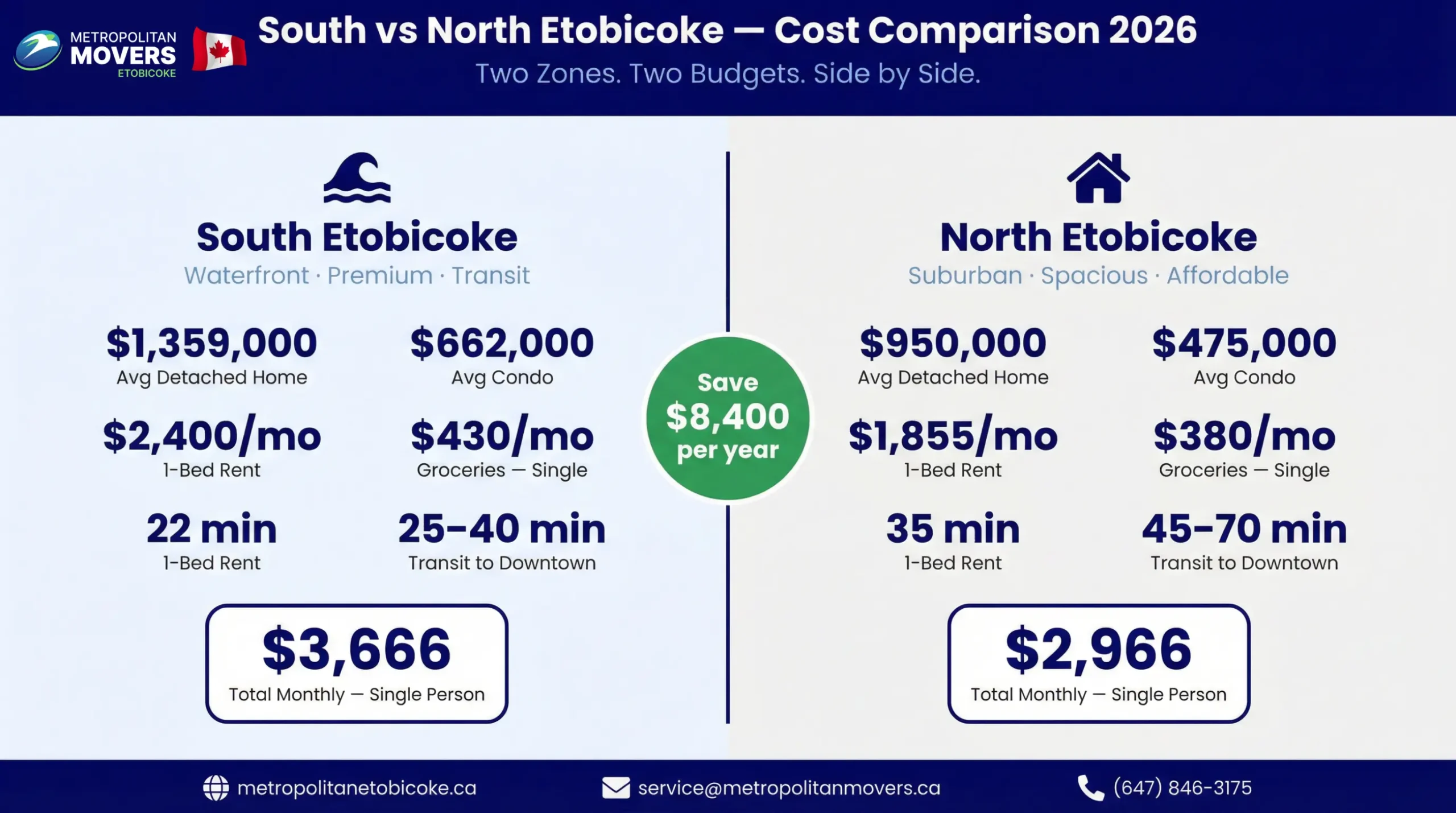
By property type, condo apartments led transaction volume with 28 sales at an average price near $662,000. Detached homes commanded the highest values, with 12 sales averaging approximately $1,359,000. These are serious numbers, and anyone planning to move into a new home in the south should factor in not just the purchase price, but also the moving logistics that come with high-rise condo buildings and narrow lakeshore streets.
What Buyers Pay in North Etobicoke — Early 2026
The north tells a very different story. Sales activity slowed compared to the prior year, reflecting a more cautious market start. Prices remained very stable, with only a marginal year-over-year shift, suggesting steady but unhurried demand.
Detached homes led the north’s market in both volume and pricing, with average sale prices falling in the $850,000 to $1,050,000 range — significantly below the $1,359,000 detached average in the south. Condos in North Etobicoke, where supply is far more limited than in the south’s condo-dense waterfront corridor, typically trade in the $400,000 to $550,000 range.
Farther into the West Mall corridor, average sold prices across all property types came in even lower, sitting in the mid-$730,000 range. This confirms what experienced buyers already know: Etobicoke is not a single market. It is a collection of micro-markets, and your neighbourhood choice alone can swing your purchase price by hundreds of thousands of dollars. Whether you ultimately buy in the south or the north, working with experienced local movers who understand both zones eliminates the logistical headaches that come with different building types and street layouts.
| Property Type | South Etobicoke | North Etobicoke | Approximate Gap |
|---|---|---|---|
| Detached Home | ~$1,359,000 | ~$950,000 | South is ~$400K higher |
| Condo Apartment | ~$662,000 | ~$475,000 | South is ~$187K higher |
| All Types Combined (Average) | ~$915,000 | ~$734,000 | South is ~$181K higher |
| Sales Volume Trend (YoY) | Up ~45% | Slowed YoY | South far more active |
| Average Days on Market | 43 days | Significantly longer | North gives buyers more time |
What Drives the Price Gap Between South and North
The premium in the south is not arbitrary. Waterfront access functions as more than an aesthetic bonus — it structurally supports long-term property values because the supply of lakefront land is finite. Every new tower that gets built on the lakeshore reduces remaining developable parcels, creating a scarcity dynamic that protects pricing even when broader GTA markets cool.
North Etobicoke’s affordability stems from a different set of factors: older housing stock that has not been renovated at scale, greater distance from rapid transit subway stations, proximity to industrial and airport-related corridors, and a perception gap that has historically dampened demand relative to the south. For buyers who prioritize square footage, lot size, and entry-level pricing, the north delivers substantially more physical space per dollar. Metropolitan Movers Etobicoke has spent over 15 years helping families navigate moves across both of these zones, and the physical requirements of each are genuinely different — from elevator bookings and loading dock scheduling in South Etobicoke’s high-rise condos to wide-driveway suburban relocations in North Etobicoke’s freehold homes.
Cost of Living in Mimico vs Rexdale: The Rental Market Divide
For renters, the South Etobicoke vs North Etobicoke cost comparison reveals one of the starkest savings opportunities in the entire Greater Toronto Area. The rental gap between these two zones is driven by building age, unit finishes, waterfront proximity, and transit access.
South Etobicoke Rent Prices: Mimico, Humber Bay Shores, Long Branch
South Etobicoke’s rental market is dominated by newer condo inventory, particularly in the Humber Bay Shores corridor where dozens of glass towers have been completed over the past fifteen years. These units offer modern finishes, lake views, rooftop amenities, and concierge services — all of which command premium rents.
One-bedroom apartments in Mimico and Humber Bay Shores range from approximately $2,000 to $2,850 per month. Two-bedroom units in newer waterfront buildings range from $2,600 to $3,600. The average listing price across all south Etobicoke unit types clusters near the $2,670 level, and properties typically spend about five weeks on the market before being leased. Well-priced units in buildings directly adjacent to transit move faster than that average suggests.
Mimico’s for-sale market shows an average transaction price around $778,000, with properties sitting on the market for roughly 40 days. The relative inaccessibility of ownership keeps rental demand elevated, as many residents who cannot yet afford to buy continue renting — maintaining consistent upward pressure on south Etobicoke rents. Renters preparing for an apartment-to-apartment move within the south need to account for elevator booking requirements and tight loading dock windows that most waterfront buildings enforce.
North Etobicoke Rental Market Analysis: Rexdale, Thistletown, West Humber
The North Etobicoke rental market analysis paints a dramatically different picture. One-bedroom apartments in the Rexdale-Kipling area range from approximately $1,719 to $1,956, with an average monthly rent near $1,855. Two-bedroom apartments in the same area range from $2,387 to $3,399, with the average sitting near $2,684.
In the neighbouring Elms-Old Rexdale area, one-bedroom pricing ranges from $1,779 to $2,267, with the average near $1,968. These figures represent real, measurable savings compared to the south — savings that compound over months and years.
The north’s rental stock consists primarily of older walk-up and mid-rise buildings from the 1960s and 1970s, many of which fall under Ontario’s rent control framework for buildings first occupied before November 15, 1991. This gives existing tenants a structural affordability advantage: annual rent increases are capped by the provincial guideline, providing budget predictability that is simply not available in the south’s newer, uncontrolled condo buildings.
Whether you are moving from one Rexdale building to another or arriving from outside the area, having professional movers who handle packing makes the transition significantly easier, particularly in older buildings without elevators where stairwell navigation requires real physical skill.
| Unit Size | South Etobicoke (Mimico/HBS) | North Etobicoke (Rexdale Area) | Monthly Savings (North) |
|---|---|---|---|
| 1-Bedroom | $2,000 – $2,850 | $1,719 – $1,968 | $200 – $880/month |
| 2-Bedroom | $2,600 – $3,600 | $2,387 – $2,766 | $200 – $830/month |
| Typical 1-Bed Midpoint | ~$2,400 | ~$1,855 | ~$545/month (~$6,540/year) |
That midpoint gap of approximately $545 per month — or roughly $6,540 per year — is enough to cover a full year of TTC monthly passes, or nearly six months of groceries for a single person.
Where Affordable Housing in North Etobicoke Concentrates
The most budget-friendly rental pockets in the north cluster around the Kipling-Albion corridor, along Rexdale Boulevard, and in the tower communities of Thistletown and West Humber. Many of these buildings benefit from the rent control protection described above. The trade-off is straightforward: these units typically lack the modern finishes, concierge services, rooftop amenities, and lake views that South Etobicoke’s condo towers provide. Whether that trade-off matters depends entirely on your priorities.
Shared housing and basement apartments offer additional savings levers in the north. Homeowners across Rexdale and Thistletown frequently rent out finished basements to offset mortgage costs, creating a supply of lower-priced units that rarely appear on major listing platforms. If you are moving out of a shared arrangement and into your first solo apartment, having your belongings packed and transported professionally prevents damage during what is often a rushed, informal transition.
South Etobicoke Gentrification Impact on Prices: Why the South Keeps Getting More Expensive
Understanding the South Etobicoke gentrification impact on prices is essential for anyone trying to time their entry into the market or anticipate future cost increases.
South Etobicoke’s lakeshore once consisted primarily of wartime bungalows, modest two-storey craftsman homes, and a mix of low-rise rental apartment buildings. That era is functionally over. Gentrification has fundamentally reshaped the zone over the past fifteen years, and several converging forces are accelerating the transformation:
- Master-planned redevelopment on former industrial land — The massive former Christie factory lands in Mimico are being transformed into a transit-oriented community spanning nearly 28 acres, bringing a brand-new GO Transit station, millions of square feet of commercial space, new retail and restaurant corridors, and thousands of residential units directly to Mimico’s doorstep. This single project will permanently alter the economic profile of the neighbourhood.
- Teardown-and-rebuild activity — Across Long Branch, New Toronto, and Mimico, older bungalows on large lots are being torn down to build two modern infill homes, or topped up with second-storey additions. This systematically raises the price floor of surrounding properties.
- Condo tower density — Humber Bay Shores has evolved from a low-density peninsula into one of the densest condo clusters in the GTA. Each new tower adds population, commercial demand, and transit pressure — all of which support rising valuations.
- Waterfront scarcity premium — Etobicoke waterfront property value is structurally protected by the simple reality that lakefront land is finite. There is no mechanism to create more of it.
The practical implication is clear: south Etobicoke prices are structurally rising due to gentrification, infrastructure investment, and scarcity. North Etobicoke prices are more stable and predictable. The gap between the two zones widens with each passing year. For families relocating into the south during peak gentrification activity, securing temporary storage while waiting for a closing date or possession day is increasingly common, as timelines can shift when multiple transactions are involved.
Etobicoke Waterfront Property Value: The Structural Premium Explained
Several factors ensure that Etobicoke waterfront property value maintains its premium position within the broader GTA market, and understanding these dynamics matters whether you are buying, renting, or investing:
- Finite lakefront land — Every parcel that gets developed reduces future supply permanently. Unlike north Etobicoke, where infill and subdivision can create new housing inventory on existing land, the south’s waterfront cannot be expanded.
- Infrastructure investment lock-in — The new Park Lawn GO station project, the 2150 Lakeshore redevelopment, and multiple condo towers currently under construction represent billions in sunk infrastructure costs. These investments permanently elevate the area’s connectivity, commercial density, and livability profile.
- Lifestyle amenity density — Cycling trails along the lake, marina access, farmers markets, diverse dining, lakeside parks, and easy transit connections to downtown Toronto create a lifestyle package that structurally supports housing demand across all price segments.
- Condo maintenance fees as a carrying cost — While not a property value driver per se, buyers should note that maintenance fees in south Etobicoke waterfront towers range from $500 to $1,200 or more per month depending on building age, amenity package, and reserve fund status. This significant carrying cost does not exist for north Etobicoke’s predominantly freehold housing stock.
North Etobicoke offers no waterfront equivalent. Its value proposition is entirely different: more physical space, lower entry prices, highway access, and proximity to the Pearson Airport employment zone. For buyers who do not prioritize lake access, the north delivers substantially more house per dollar. Moving specialty items like grand pianos into a south Etobicoke high-rise requires specialized equipment and advance coordination with building management — a very different operation than bringing that same piano through the wide front door of a north Etobicoke detached home.
Commuting Expenses from North vs South Etobicoke: The Hidden Budget Line
Your monthly commuting costs can add hundreds of dollars to your effective cost of living, and the two zones offer dramatically different transit profiles.
South Etobicoke: Multiple Rapid Transit Options
South Etobicoke benefits from several direct rapid transit connections that make downtown commuting both fast and predictable:
- GO Transit Lakeshore West line — Stations at Mimico and Long Branch provide service to Union Station. The ride from Mimico to Union takes approximately 13 minutes on express trains, making it one of the shortest GO commutes in the GTA.
- TTC streetcar and bus network — The Lake Shore streetcar route connects the south to the broader east-west transit network, while bus routes feed into Royal York, Islington, and Kipling subway stations on Line 2.
- Cycling infrastructure — The Martin Goodman Trail and Waterfront Trail provide dedicated cycling corridors into the downtown core for fair-weather commuters.
A monthly GO pass from Mimico to Union Station runs approximately $206 to $248 depending on fare zone and pass type.
North Etobicoke: Highway-Oriented but Improving
North Etobicoke’s transit picture is fundamentally different — historically car-dependent, but improving:
- Line 6 Finch West LRT — Opened in December 2025, this new light rail line connects northwest Etobicoke to Line 1 at Finch West station. It represents the single biggest transit improvement for the north in a generation, directly serving Humber College’s north campus and surrounding communities.
- GO Transit Kitchener line — The Etobicoke North station sits on this corridor, but service frequency is significantly lower than the Lakeshore West line, making it less practical for daily commuting.
- TTC bus network — The primary transit mode for most north Etobicoke residents, with routes feeding into Kipling station on Line 2. Bus commutes to Kipling can take 25 to 45 minutes depending on distance and traffic conditions.
- Highway access — Highways 427, 401, and 409 border the area, making car commuting practical for those working outside the downtown core.
| Commute Mode | From South Etobicoke | From North Etobicoke |
|---|---|---|
| GO Transit Monthly Pass | ~$206 – $248 (Lakeshore West) | ~$248 – $280 (Kitchener, less frequent) |
| TTC Monthly Pass Only | $156 (bus/streetcar to subway) | $156 (bus to Kipling, longer ride) |
| Car (Gas + Insurance + Parking) | ~$500 – $700/month | ~$520 – $770/month |
| Typical Door-to-Door Transit Time | 25 – 40 minutes | 45 – 70 minutes |
The Time-Value Calculation That Changes Everything
Here is where the math gets genuinely interesting. If you save $545 per month in rent by choosing north Etobicoke over the south, but your daily commute adds 50 minutes round trip at a conservative time value of $25 per hour, that additional commute time costs you roughly $455 per month in lost productive time. The net financial savings shrink to approximately $90 per month — still positive, but far less dramatic than the raw rent difference implies.
However, if you work remotely, freelance from home, or commute to Pearson Airport or the Highway 401/427 employment corridors rather than downtown, north Etobicoke’s commuting cost advantage flips entirely in its favour. The area’s highway access becomes a strength, not a limitation. Long-distance movers see this pattern frequently: professionals relocating from other provinces for airport-area jobs consistently choose north Etobicoke for its combination of affordability and highway proximity.
Lifestyle Differences and Costs in Etobicoke Regions
Beyond shelter and commuting, the lifestyle cost profile between south and north Etobicoke diverges in ways that affect your monthly spending.
Groceries and Dining: Where Your Food Dollar Stretches Further
Both zones are served by major Canadian grocery chains, but the retail mix creates a genuine spending difference. South Etobicoke’s Lake Shore Boulevard corridor features an increasingly upscale selection of cafes, restaurants, brunch spots, and specialty food shops — a direct consequence of gentrification. North Etobicoke’s Albion-Kipling corridor and Rexdale Boulevard strip feature some of the GTA’s best-value ethnic grocery stores, produce markets, halal butchers, and budget-friendly dining spots. For a household that shops strategically, monthly grocery costs in the north can run ten to fifteen percent below the south — not because food prices differ chain-to-chain, but because the available retail mix skews heavily toward discount and ethnic grocers rather than premium boutiques.
- South Etobicoke grocery spending (single person): $375 to $500/month
- North Etobicoke grocery spending (single person): $325 to $440/month
- South Etobicoke dining out (moderate, couple): $300 to $500/month
- North Etobicoke dining out (moderate, couple): $200 to $350/month
If you are relocating from a neighbourhood with different grocery options, having your kitchen packed properly ensures your spice collections, small appliances, and fragile dishware survive the transition. It is one of the most commonly damaged categories during self-managed moves.
Recreation, Green Space, and Entertainment
South Etobicoke’s recreational advantages are anchored in its waterfront. Mimico and Humber Bay Shores offer cycling trails along the Martin Goodman Trail, direct lake access, parks with waterfront views, and a growing roster of patios, cafes, and seasonal markets. These amenities are largely free to enjoy, which means the south’s lifestyle premium does not always translate into higher daily recreation spending — the premium is embedded in your rent or mortgage, not in your entertainment budget.
North Etobicoke’s recreational profile centres on Centennial Park — one of Toronto’s largest municipal parks offering cross-country skiing, a splash pad, sports fields, and a municipal golf course — along with Pine Point Park, Rexdale Park, Royal Crest Park, and the Humber River trail system. The Humber trails offer a quiet, forested character that is genuinely distinct from the lakefront experience in the south. Woodbine Mall, with over 130 stores and a year-round indoor amusement park, provides an entertainment hub that the south lacks.
For families with large outdoor play equipment, trampolines, or patio furniture to move, north Etobicoke’s larger yards and driveways make the logistics considerably simpler than navigating south Etobicoke’s high-rise elevator systems.
Schools and Childcare
Both zones fall under the Toronto District School Board and Toronto Catholic District School Board, so public education costs are identical. South Etobicoke benefits from proximity to Humber College’s Lakeshore Campus, while north Etobicoke is home to the University of Guelph-Humber and Humber College’s north campus.
Licensed childcare runs $1,000 to $1,200 per month per child across both zones. Availability varies — newer south Etobicoke developments sometimes include ground-floor daycare centres, while north Etobicoke’s childcare network is more established within its older residential fabric. Senior families who are downsizing as children leave home often find the north’s single-level bungalows easier to manage than the south’s multi-storey infill houses.
The Complete Monthly Budget: South vs North Etobicoke Side by Side
Bringing all cost categories together, here is what a complete monthly budget looks like for a renter in each zone. These figures assume TTC transit use (not car ownership), moderate grocery spending, and standard utility costs from the city’s current rate structure.
| Expense Category | South (Single) | North (Single) | South (Family of 4) | North (Family of 4) |
|---|---|---|---|---|
| Rent (1-Bed / 3-Bed) | $2,400 | $1,855 | $3,600 | $3,000 |
| Groceries | $430 | $380 | $1,400 | $1,250 |
| Transportation | $206 | $156 | $620 | $620 |
| Utilities (Hydro, Gas, Water) | $160 | $160 | $250 | $250 |
| Internet + Mobile | $120 | $120 | $185 | $185 |
| Tenant / Home Insurance | $50 | $45 | $75 | $65 |
| Personal + Entertainment | $300 | $250 | $500 | $425 |
| ESTIMATED MONTHLY TOTAL | $3,666 | $2,966 | $6,630 | $5,795 |
| ANNUAL DIFFERENCE | North saves ~$8,400/year for singles | North saves ~$10,020/year for families | ||
A family choosing north Etobicoke over south Etobicoke saves roughly $10,000 per year — enough to cover professional moving and packing services, a family vacation, or a meaningful annual contribution to education savings. These are not theoretical numbers. They compound year after year and fundamentally shape long-term financial health.
Which Zone Matches Your Financial Profile
The South Etobicoke vs North Etobicoke cost comparison does not produce a universal winner. The right choice depends entirely on your household’s income, work location, lifestyle priorities, and long-term plans.
South Etobicoke Aligns With Your Budget When You:
- Work downtown and value a short GO Transit commute — 13 minutes from Mimico to Union Station
- Prioritize waterfront lifestyle amenities, walkability, and cycling infrastructure
- Plan to build equity in a market supported by gentrification and infrastructure investment
- Accept smaller living space in exchange for a premium location and stronger resale trajectory
- Work remotely but want immediate access to cafes, restaurants, and the lakeshore during non-working hours
- Are an investor seeking condo units with strong rental demand driven by young professionals
If you are moving into a south Etobicoke condo, coordinating an office-style logistics approach — with scheduled elevator windows, insurance certificates, and building management coordination — keeps the process on track.
North Etobicoke Aligns With Your Budget When You:
- Work near Pearson Airport, the Highway 401 corridor, or the Woodbine employment zone
- Need maximum square footage and lot size per dollar for a growing family
- Want a freehold home with a backyard, a garage, and a driveway
- Prefer to keep monthly housing costs as low as possible and redirect savings elsewhere
- Are comfortable with a longer TTC bus commute or rely on a car for daily transportation
- Are a first-time buyer looking for the most accessible entry point within Toronto’s boundaries
North Etobicoke’s ground-level homes make furniture removals and large item deliveries significantly simpler than navigating the high-rise logistics typical of the south.
Planning Your Move by Zone: What Each Side of Etobicoke Demands
The physical logistics of moving differ significantly between south and north Etobicoke, and preparation saves both time and money.
South Etobicoke Moves Typically Involve:
- High-rise condo logistics — Elevator booking (often limited to a 4-hour window), loading dock scheduling, building insurance certificate requirements, and narrow hallway navigation through common areas
- Street parking permits — Moving trucks on busy Lake Shore Boulevard, Park Lawn Road, and Mimico residential streets often require City of Toronto parking permits arranged days in advance
- Smaller unit volumes but higher complexity — A studio or one-bedroom move may seem simple, but the building logistics add layers of coordination
- Fragile and high-value items in compact spaces — Professional packing is essential when manoeuvring through tight hallways and elevators where one wrong angle can damage both your belongings and the building’s walls
If you are moving from another part of Toronto into the south, planning for these building-specific requirements at least two weeks before moving day prevents last-minute scrambles.
North Etobicoke Moves Typically Involve:
- Detached home logistics — Larger overall volume of belongings, basements packed with years of accumulated storage, garages filled with tools and seasonal equipment, and backyards with furniture and play structures
- Wider driveways and easier truck access — Most north Etobicoke streets accommodate full-size moving trucks without permits
- Multiple-level homes — Bungalows and two-storey houses require stairwell and doorway navigation for large furniture pieces like sectional sofas, king-size bed frames, and dining tables
- Longer distances from donation centres and disposal sites — Decluttering before a move is critical; downsizing specialists can help families sort, donate, and dispose before packing day
For households moving long distance into north Etobicoke from another province, the area’s wide residential streets and straightforward access make the delivery and unloading process far more predictable than the permitting and elevator-booking requirements of the south.
Metropolitan Movers Etobicoke has over 15 years of experience serving every neighbourhood across both zones. We understand that a condo move in Humber Bay Shores is a fundamentally different operation than a detached home move in Thistletown — and we plan, price, and execute accordingly. Every quote is customized to your specific zone, building type, and volume. If you need temporary storage between moves, we offer secure, accessible options that bridge the gap between your move-out and move-in dates.
The Bottom Line on South vs North Etobicoke: Making the Right Financial Choice for Your Household
The straightforward reality is that south Etobicoke and north Etobicoke serve fundamentally different financial profiles, and neither zone is objectively superior — only more or less aligned with your specific situation.
South Etobicoke commands premium pricing for waterfront access, rapid transit connectivity, walkability, and a gentrification trajectory that supports long-term property value growth. Single professionals can expect to spend approximately $3,666 per month. Families of four should budget around $6,630. The premium buys lifestyle quality and commute efficiency that many residents consider well worth the cost.
North Etobicoke delivers measurably more affordable housing, more physical space per dollar, and practical advantages for car commuters and airport-area workers. Singles can live on approximately $2,966 per month. Families can operate at roughly $5,795. The annual savings of $8,400 to $10,000 compared to the south represent real financial flexibility — money that can go toward savings, education, debt reduction, or quality-of-life investments that the budget does not otherwise allow.
The right question is not which zone is cheaper — north Etobicoke will always win that contest. The right question is which zone’s total cost equation, including commute time, lifestyle fit, and long-term asset trajectory, delivers the best alignment with your household’s income, priorities, and five-year plan.
Whichever zone you choose, locking in your relocation costs early with Metropolitan Movers Etobicoke ensures that the transition itself remains a controlled, predictable line item rather than an unpleasant financial surprise. Get a customized estimate based on your specific building type, neighbourhood, and belongings — and make your Etobicoke move with full financial clarity.
Frequently Asked Questions About South vs North Etobicoke Costs
How much cheaper is renting in North Etobicoke compared to South Etobicoke?
One-bedroom apartments in North Etobicoke’s Rexdale-Kipling area average approximately $1,855 per month, compared to approximately $2,400 in South Etobicoke’s Mimico and Humber Bay Shores corridor. That represents a typical monthly savings of around $545, or roughly $6,540 per year. Two-bedroom units show a similar gap, with north averages near $2,684 compared to $3,000 or more in the south.
What is the average home price in South Etobicoke in 2026?
The average home sale price in South Etobicoke was approximately $915,000 as of early 2026. Detached homes averaged roughly $1,359,000, while condo apartments averaged approximately $662,000. Sales volume increased nearly 45 percent year-over-year, indicating strong and growing buyer demand across the district.
Is North Etobicoke a good place to buy affordable housing?
North Etobicoke remains one of the most affordable areas within Toronto’s municipal boundaries for purchasing a home. Detached homes in the district trade in the $850,000 to $1,050,000 range — significantly below the South Etobicoke average. The area’s older post-war housing stock offers larger lots and more physical living space per dollar. Highway access to the 401, 427, and 409 is a major draw for commuters working outside the downtown core or near Pearson Airport.
How does gentrification in Mimico affect housing prices?
The gentrification wave in Mimico and broader South Etobicoke has been transformative. Former industrial lands are being redeveloped into massive transit-oriented communities. Older bungalows on large lots are being torn down and replaced with modern infill homes or topped up with second-storey additions. Each round of redevelopment raises the price floor for surrounding properties, creating a sustained upward pressure on values that has persisted for over a decade and shows no signs of slowing.
Which zone has better transit for commuting to downtown?
South Etobicoke has a clear commuting advantage for downtown-bound workers. The Mimico GO station offers a roughly 13-minute ride to Union Station on the frequently running Lakeshore West line. North Etobicoke’s GO station sits on the less frequent Kitchener line, and most residents commute via TTC bus to Kipling subway station — adding 25 to 45 minutes of travel time before even reaching the subway. The Line 6 Finch West LRT, opened in December 2025, has improved northwest Etobicoke’s rapid transit connectivity, but it connects to Line 1 at Finch rather than directly downtown.
What is the Etobicoke waterfront property value outlook for 2026?
Waterfront property values in South Etobicoke are structurally supported by finite lakefront land, billions in ongoing infrastructure investment including a new GO station and master-planned communities, and a lifestyle amenity package that includes cycling trails, parks, marinas, and direct lake access. These factors create price resilience even when broader markets soften, because the supply constraint cannot be resolved.
Do grocery costs differ between South and North Etobicoke?
Both zones are served by the same major grocery chains, so shelf prices at any given retailer are identical. However, North Etobicoke offers significantly more budget-oriented options — particularly along the Albion-Kipling corridor, where ethnic grocery stores and produce markets provide exceptional value on fresh produce, spices, and proteins. A strategic shopper in the north can reduce monthly grocery spending by ten to fifteen percent compared to relying primarily on the south’s more premium-oriented retail mix.
How much can a family save by choosing North Etobicoke over South?
A family of four renting in North Etobicoke can save approximately $835 per month compared to an equivalent family in South Etobicoke — roughly $10,020 per year. The difference is driven primarily by rent (approximately $600/month gap), groceries (approximately $150/month gap), and lifestyle spending (approximately $75/month gap). Utility costs and TTC pass prices are essentially identical between the two zones.
When is the best time of year to move in Etobicoke?
The GTA rental market is most competitive from June through September, when demand peaks from students, graduates, and families settling before the school year. Moving during winter months — November through February — typically yields better rental pricing, more landlord flexibility, and lower demand for professional moving services. If your timeline is flexible, a winter move can save money on both rent negotiations and relocation costs.
Is it better to rent or buy in North Etobicoke?
This depends on your financial position and timeline. North Etobicoke offers some of the most accessible homeownership entry points within Toronto, with detached homes available in the $850,000 to $1,050,000 range. However, the area’s older housing stock may require renovation investment. Renting provides flexibility and lower upfront costs, especially for newcomers testing the area before committing to a purchase. Both paths are financially viable — the choice depends on your down payment capacity, income stability, and how long you plan to stay.