

For families, seniors, and professionals weighing a move across the city, the question of safety is rarely far from the top of the list. Is Etobicoke safer than downtown Toronto? It is one of the most frequently asked questions by anyone considering a relocation to the western edge of the city — and it deserves a thorough, data-grounded answer rather than a vague reassurance. This guide examines Toronto Police Service Major Crime Indicators, neighborhood-level crime rate comparisons, safety profiles for specific Etobicoke communities, and the practical factors that matter most to families, seniors, and newcomers. For anyone exploring the broader question of what life in Etobicoke actually costs and delivers day to day, the Etobicoke cost of living guide for 2026 is the essential companion to this analysis.
How Toronto Measures Crime and Why the Method Matters
Before drawing any meaningful comparison between Etobicoke and downtown Toronto, it is necessary to understand how crime is officially measured and reported across the city. The Toronto Police Service uses Major Crime Indicators — commonly referred to as MCIs — as its primary framework for tracking and comparing criminal activity across Toronto’s defined neighborhoods. The MCI categories are:
- Assault — the largest single category, comprising approximately 54% of all MCIs
- Break and Enter
- Auto Theft
- Robbery
- Theft Over $5,000
- Homicide
- Sexual Violation
The Toronto Police Service Public Safety Data Portal publishes this data publicly, updated on a regular basis, allowing residents and researchers to filter by neighborhood, division, category, and time period. This transparency is one of the most valuable resources available to anyone making a relocation decision based on objective safety data.
The critical methodological point — one that most general safety discussions overlook — is that raw crime counts are deeply misleading without population context. A neighborhood reporting 200 incidents annually with 5,000 residents is statistically far more dangerous than one reporting 400 incidents with 40,000 residents. The correct measure is crime rate per 1,000 residents, and that is the lens through which Etobicoke and downtown Toronto need to be compared honestly.
Toronto’s overall safety index places it consistently among the safest large metropolitan cities in North America. According to the Economist Intelligence Unit’s Safe Cities Index, Toronto ranks in the global top ten for urban safety — a city-wide baseline that means both Etobicoke and downtown Toronto are operating from a foundation that is already among the strongest of any major urban centre in the world. The relevant question is not whether Toronto is safe, but which parts of it are safer than others — and by how much.
Etobicoke vs. Downtown Toronto: What the Crime Data Actually Shows
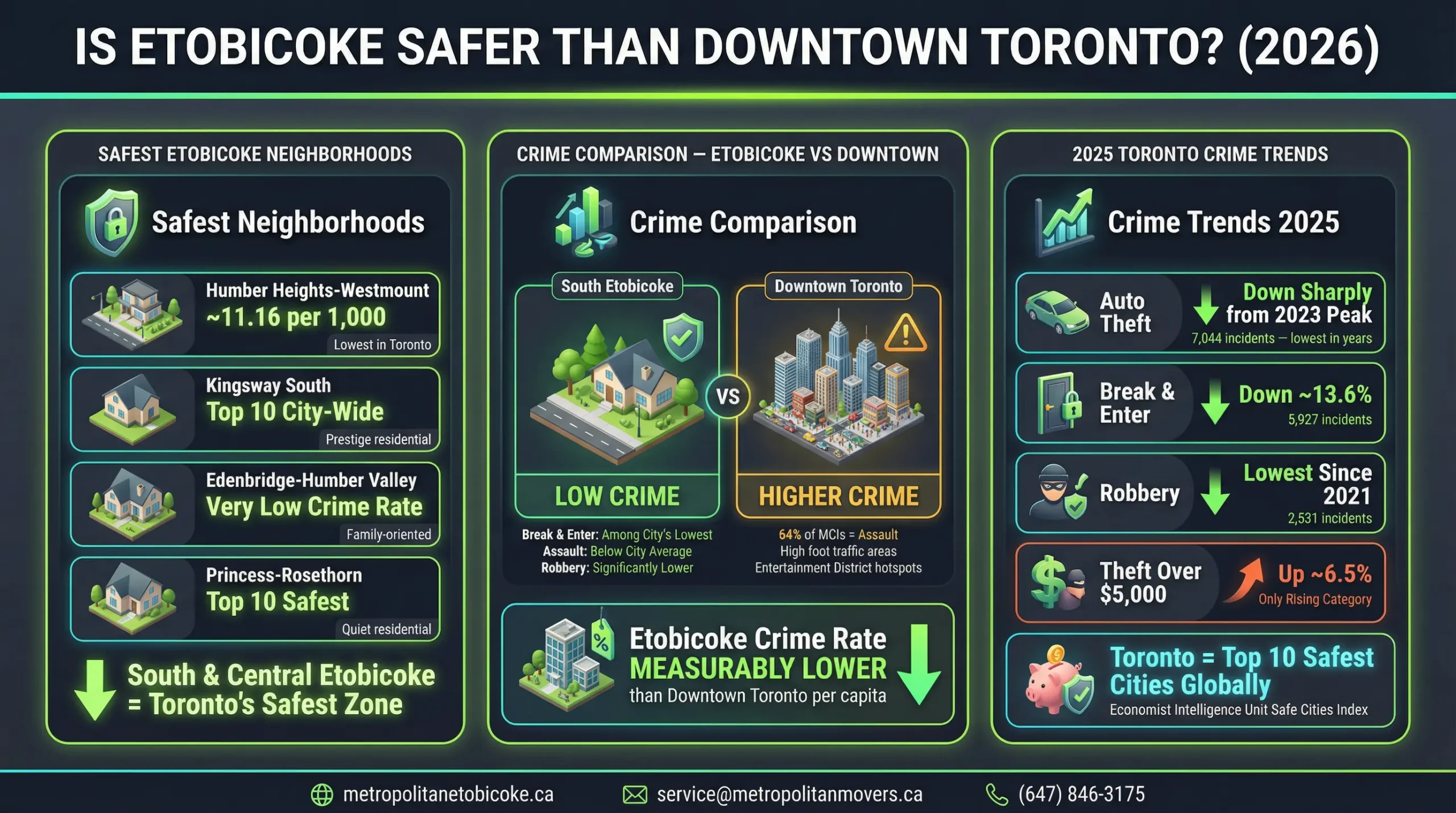
The data from Toronto Police MCI records consistently shows that Etobicoke, as a district, records lower crime rates per capita than the downtown core. This reflects a pattern seen across virtually every major North American city — lower-density residential areas generate fewer incidents per resident than high-footfall urban cores with dense concentrations of commercial activity, nightlife, transit hubs, and transient populations moving through public space.
Looking at crime data represented across Toronto’s neighborhoods, Etobicoke communities — particularly in the south and central portions of the district — consistently record crime rates that are below the city average and well below the rates recorded in Toronto’s most active downtown corridors. Even areas within Etobicoke that are considered higher-crime relative to the district’s own average still benchmark favorably against many downtown neighborhoods when measured on a per-capita basis.
The downtown core’s higher crime numbers are driven primarily by the Entertainment District, corridors adjacent to Yonge and Dundas, and areas surrounding major transit hubs where foot traffic — and therefore opportunity crime — is substantially amplified by sheer volume of people passing through. Residential streets in downtown condo communities register crime rates that are more comparable to South Etobicoke neighborhoods, but these represent only a fraction of the overall downtown geography. The average across downtown as a whole pulls significantly higher than what Etobicoke’s residential communities record annually.
Assault consistently represents the largest share of reported major crime across Toronto — roughly 54% of all MCI incidents. This category disproportionately affects high-density urban areas with active nightlife and busy transit corridors — environments that characterize downtown Toronto far more than the residential streets of South and Central Etobicoke.
The Safest Neighborhoods in Etobicoke: A Data-Driven Breakdown
Etobicoke is not a monolithic safety zone — it is a large and internally varied district. Understanding which specific communities consistently register the lowest crime rates is essential for anyone making location decisions within the district.
Based on Toronto Police MCI data, several Etobicoke neighborhoods rank among the safest in the entire City of Toronto. Humber Heights-Westmount, Kingsway South, Princess-Rosethorn, and Edenbridge-Humber Valley are the communities that appear most consistently at the top of city-wide neighborhood safety rankings. These areas are positioned away from major commercial corridors, feature low-density residential street layouts, and record crime rates that are among the lowest available at any address within Toronto’s municipal boundaries.
Humber Heights-Westmount, situated in northeastern Etobicoke along the Humber River corridor, reports a crime rate of approximately 11.16 incidents per 1,000 residents — one of the lowest figures recorded across the city. The neighborhood is defined by parkland, mature tree canopy, and quiet residential streets that produce a safety profile comparable to communities far outside the urban core.
Kingsway South and The Kingsway consistently appear in city-wide top-ten neighborhood safety rankings, with break-and-enter incidents in the South Etobicoke area among the lowest recorded across all Toronto divisions. Princess-Rosethorn and Edenbridge-Humber Valley similarly maintain very low crime rates year over year, driven by their residential character, high homeownership rates, and the absence of the commercial nightlife activity that elevates crime in more urbanized neighborhoods.
| Etobicoke Neighborhood | Area | Safety Profile | Crime Rate Per 1,000 | Best Known For |
|---|---|---|---|---|
| Humber Heights-Westmount | Northeast Etobicoke | Among Toronto’s safest | ~11.16 | Humber River trails, parkland, quiet streets |
| Kingsway South | South-Central Etobicoke | Consistently top 10 city-wide | Very low | Prestige homes, tree-lined streets, strong community |
| Edenbridge-Humber Valley | Central Etobicoke | Top-ranked year over year | Very low | Large lots, strong schools, green corridors |
| Princess-Rosethorn | Central Etobicoke | Top 10 safest in Toronto | Very low | Quiet residential, family-oriented, mature trees |
| New Toronto and Mimico | South Etobicoke | Below-average crime, waterfront access | Low to moderate | Lakefront lifestyle, GO Train proximity |
| West Humber-Clairville | North Etobicoke | Higher relative to Etobicoke average | Moderate to higher | Affordable housing, highway access, commercial activity |
North Etobicoke vs. South Etobicoke: Understanding the Internal Safety Divide
One of the most important nuances in any Etobicoke safety analysis is the meaningful difference between the district’s northern and southern halves. Treating Etobicoke as a single uniform safety zone misrepresents a significant internal divide that runs roughly along the Highway 401 corridor.
South Etobicoke — encompassing Mimico, New Toronto, Long Branch, Alderwood, Islington Village, Sunnylea, and The Kingsway — is a predominantly residential area with lower population density, mature housing stock, and a demographic profile that skews toward established families and working professionals. Crime rates in South Etobicoke are among the lowest in the entire City of Toronto, and several of these communities appear regularly in city-wide top-ten safety rankings derived from Toronto Police MCI data.
Central Etobicoke — covering Edenbridge-Humber Valley, Princess-Rosethorn, Markland Wood, and Humber Heights-Westmount — maintains similarly low crime rates and consistently ranks among Toronto’s safest residential zones. What truly sets these communities apart is the balance between city conveniences and genuine suburban character. Parks, conservation corridors, and proximity to Lake Ontario create a lifestyle that is difficult to replicate in denser parts of the city, while strong school performance and high homeownership rates contribute to the community stability that underlies long-term safety outcomes.
North Etobicoke — including Rexdale, Thistletown, and West Humber-Clairville — presents a different picture. These communities have historically registered higher crime rates relative to the Etobicoke district average, driven by a combination of higher population density in affordable housing clusters, proximity to major commercial corridors, and socioeconomic factors that influence crime patterns across most North American cities. That said, even the higher-end figures from North Etobicoke remain competitive with — and frequently below — the crime rates recorded across downtown Toronto’s broader geography when measured on a per-capita basis.
For anyone relocating to Etobicoke with safety as a primary criterion, the specific neighborhood matters far more than the district label. South and Central Etobicoke provide one of the safest residential environments available anywhere within Toronto’s city limits.
Auto Theft in Etobicoke: The One Category That Warrants Specific Attention
Auto theft is the one crime category that warrants a dedicated discussion in any Etobicoke safety analysis — because it is the area where the district’s suburban character creates a vulnerability that differs from the downtown pattern.
Auto theft has declined significantly across Toronto since the sharp spike recorded in 2023. By late 2025, police recorded approximately 7,044 vehicle thefts city-wide — the lowest annual total in several years and a sharp reduction from the period when organized auto theft dominated Toronto crime statistics. As a proportion of all major crime incidents, auto theft dropped from 27.7% in 2023 to approximately 15.6% in 2025 — a meaningful improvement driven by enforcement efforts, increased public awareness, and improved vehicle security technology.
Etobicoke’s proximity to Highway 401 and Highway 427 — the primary corridors used to rapidly move stolen vehicles out of the city — has historically made it an area of interest for organized auto theft rings. Residential driveways and surface parking lots in suburban neighborhoods are also more accessible to vehicle thieves than the secured underground garages that characterize much of downtown’s condo residential stock.
The declining trend is encouraging and reflects genuine improvement across the district. However, Etobicoke residents with newer or high-value vehicles are well-advised to maintain practical precautions: a steering wheel lock, an aftermarket GPS tracking device, and the habit of parking in well-lit or enclosed locations when available. These are low-cost, high-impact measures that significantly reduce individual risk regardless of what neighborhood you live in.
What Makes Etobicoke Feel Safer: The Factors That Statistics Cannot Capture
Raw crime data tells only part of the safety story. The lived experience of security in a neighborhood is shaped by factors that no spreadsheet can fully capture — and Etobicoke scores consistently well on most of them.
Lower population density and reduced foot traffic: Residential streets in South and Central Etobicoke see dramatically less pedestrian volume than downtown Toronto’s commercial corridors. Lower foot traffic reduces random encounters, decreases opportunity crime, and increases the likelihood that unusual activity is noticed and reported by neighbors who recognize each other.
Strong community cohesion: In communities like Kingsway South, Sunnylea, and Princess-Rosethorn, neighbors know each other by name, look out for each other’s properties, and maintain the kind of informal social surveillance that is one of the most effective deterrents to residential crime that exists in any neighborhood setting.
Abundant green space and active outdoor culture: The abundance of parks, trails, conservation corridors, and waterfront access throughout Etobicoke contributes to community well-being and outdoor activity patterns that are consistently associated with lower crime rates in residential planning research. Active parks with regular users create natural informal surveillance that deters opportunistic crime throughout the day.
Improved transit infrastructure reducing isolation: The opening of Line 5 Eglinton in February 2026 and Line 6 Finch West in December 2025 have meaningfully expanded transit connectivity across Etobicoke, reducing car dependency in targeted areas and creating more active, surveilled public spaces along major corridors. Better-connected neighborhoods with more people moving through them safely during daylight hours are structurally safer than isolated suburban pockets with limited transit.
Healthcare infrastructure within reach: Etobicoke General Hospital and Humber River Health’s fully digital campus provide world-class emergency and specialist care within minutes of any Etobicoke address. Access to healthcare — particularly mental health services — is one of the structural community factors associated with long-term safety outcomes in residential neighborhoods.
Is Etobicoke Safe for Families with Children?
For families specifically — the demographic for whom neighborhood safety carries the most weight — Etobicoke is one of the strongest choices available within Toronto’s municipal boundaries. Families seeking a safe and welcoming environment will find it across Etobicoke’s residential communities, which are home to excellent schools, well-maintained parks, and accessible community centres that collectively provide everything a growing household needs within a short distance of home.
The family-friendly neighborhoods in Etobicoke — The Kingsway, Edenbridge-Humber Valley, Princess-Rosethorn, Markland Wood, Sunnylea, Alderwood, Long Branch, and Mimico — each offer a distinct version of the same fundamental promise: a place where children can grow up safely, learn in strong schools, play in genuine green spaces, and belong to a community that values family life.
Etobicoke is home to 52 public and 30 Catholic elementary schools, and the district generally ranks above the Ontario average in EQAO pass rates in reading, writing, and mathematics. Among the consistently highest-performing schools are Lambton-Kingsway Junior Middle School, Humber Valley Village JMS, Sunnylea Junior Public School, John English Junior Middle School, and Rosethorn Junior School.
For families with school-age children, the combination of low crime rates in South and Central Etobicoke, strong school performance, abundant parkland, and quieter residential streets creates a genuinely compelling argument for prioritizing Etobicoke over a downtown address — even if it means a slightly longer commute for one or both parents.
Is Etobicoke Safe for Seniors?
South Etobicoke’s relaxed and family-oriented character, combined with Central Etobicoke’s vibrant suburban streets and accessible green corridors, translates directly into qualities that seniors value most in a residential environment: walkable streets, low ambient noise, accessible parks, community programs, and neighbors who are present and attentive.
The senior moving services offered by Metropolitan Movers Etobicoke serve clients relocating from all parts of the GTA and from across the country specifically because Etobicoke’s combination of residential safety, healthcare proximity, and community warmth makes it one of the most sought-after destinations for older adults choosing to age in place or downsize within Toronto.
For seniors relocating from within the city or arriving from other provinces — whether completing a long-distance move from Halifax or Winnipeg — the flat terrain of South Etobicoke, the abundance of paved waterfront trails, and the proximity of Etobicoke General Hospital make this district a highly practical as well as emotionally rewarding environment for the next chapter of life.
Downtown Toronto Safety: A Fair and Balanced Assessment
In the interest of genuine balance, it is important to acknowledge that downtown Toronto is far from an unsafe place to live. Toronto’s Crime Severity Index remains significantly below the national average and well below comparable figures for cities like Winnipeg, Edmonton, and Saskatoon. By virtually any international benchmark, downtown Toronto is a safe urban environment.
The key distinction is not absolute danger — it is the type of crime and who is most exposed to it. Downtown Toronto’s higher MCI numbers are driven substantially by high-footfall commercial areas, transit hubs, and entertainment districts where opportunity crime is elevated by sheer volume of people moving through the same spaces. Residents of downtown condominium buildings on quieter streets often experience safety profiles that are comparable to suburban neighborhoods during evening hours.
The practical difference for families and seniors is structural. Etobicoke’s residential streets are fundamentally less exposed to the environmental conditions that drive downtown crime: fewer strangers passing through, less nighttime commercial activity, more stable and familiar neighbors, and lower population density. Those structural differences produce consistently lower per-capita crime rates at the neighborhood level — and that pattern holds year after year in Toronto Police MCI data.
Toronto Crime Trends in 2025–2026: The Broader Picture
Across most major crime categories, Toronto recorded meaningful improvements through 2025. Break-and-enter reports continued to decline, reaching approximately 5,927 incidents by late 2025 — down roughly 13.6% from the same point in 2024 and the lowest annual total in several years. Robbery figures similarly fell to their lowest level since 2021, with approximately 2,531 incidents recorded, compared with over 3,100 at the same point in 2024.
Auto theft declined significantly from the historic peak of 2023, with approximately 7,044 incidents recorded in 2025 — the lowest annual total in several years and a reflection of both enforcement efforts and improved public awareness of vehicle security measures.
The one crime category that moved against the overall trend was high-value theft — specifically theft over $5,000 — which rose approximately 6.5% year over year, making it the only major crime category to increase in 2025. This category is primarily concentrated in commercial areas and is less directly tied to the residential neighborhood safety experience in Etobicoke’s lower-density communities.
| Crime Category | Toronto 2025 Trend | Etobicoke Impact | Relative Risk vs. Downtown |
|---|---|---|---|
| Assault | Stable (~54% of all MCIs) | Lower in residential South and Central Etobicoke | Significantly lower than downtown core |
| Break and Enter | Down ~13.6% year over year | South Etobicoke among city’s lowest | Lower than downtown average |
| Auto Theft | Down sharply from 2023 peak | Elevated relative to other Etobicoke categories | Similar to or slightly above downtown |
| Robbery | Lowest since 2021 | Low throughout most of Etobicoke | Significantly lower than downtown |
| Theft Over $5,000 | Up ~6.5% (only rising category) | Primarily affects commercial areas | Concentrated in downtown commercial zones |
| Homicide | 38 city-wide by late December 2025 | Rare in South and Central Etobicoke | Lower than downtown and North Etobicoke |
Practical Safety Tips for New Etobicoke Residents
Whether you are moving locally within Etobicoke or arriving from Vancouver, Calgary, or Edmonton, settling into a new neighborhood with smart safety awareness from day one is always a worthwhile investment of time:
- Register for Toronto Police Service Community Notification email alerts, which deliver real-time crime notifications filtered by neighborhood directly to your inbox
- Join your local NextDoor or neighborhood Facebook group — these hyperlocal networks are where residents share observations and coordinate faster than any official channel
- Invest in a steering wheel lock and GPS tracker for your vehicle, particularly if you park on a driveway rather than in an enclosed garage in North or Central Etobicoke
- Introduce yourself to immediate neighbors early — community cohesion is one of the strongest structural predictors of residential safety, and a street where people recognize each other is measurably safer than one where they do not
- Use the Toronto Police Neighbourhood Crime Reports portal at data.torontopolice.on.ca to look up specific crime counts for your exact neighborhood before and after your move
For families relocating from cities like Saskatoon, Regina, or Winnipeg — where Crime Severity Indexes are substantially higher than Toronto’s — moving to Etobicoke represents a genuine and measurable improvement in day-to-day safety by every available metric.
Frequently Asked Questions
Is Etobicoke safer than downtown Toronto? Yes, based on Toronto Police MCI data and per-capita crime rate comparisons, most Etobicoke neighborhoods — particularly in South and Central Etobicoke — record lower crime rates than the downtown core. The difference is structural: lower population density, less commercial nightlife activity, and more stable residential demographics in Etobicoke’s family-oriented communities produce consistently better per-capita safety outcomes.
What are the safest neighborhoods in Etobicoke? Based on Toronto Police data, the consistently safest Etobicoke communities are Humber Heights-Westmount, Kingsway South, Edenbridge-Humber Valley, Princess-Rosethorn, New Toronto, Sunnylea, and Mimico. Multiple Etobicoke neighborhoods appear in city-wide top-ten safety rankings year after year.
Is North Etobicoke safe? North Etobicoke — particularly West Humber-Clairville and parts of Rexdale — records higher crime rates relative to the Etobicoke district average. However, even these areas generally benchmark comparably to or below many downtown Toronto neighborhoods on a per-capita basis. North Etobicoke’s higher figures are relative to the rest of the district, not absolute in a broader city context.
What type of crime is most common in Etobicoke? Assault is the most reported MCI category across Toronto as a whole, comprising approximately 54% of all major crime indicators. Auto theft is the category where Etobicoke’s suburban character creates somewhat elevated risk relative to some downtown neighborhoods with secured parking infrastructure. Break-and-enter rates are declining across the city and are particularly low in South Etobicoke.
Does Metropolitan Movers Etobicoke handle moves across all parts of Etobicoke? Yes. Metropolitan Movers Etobicoke provides residential moving services, senior relocation support, local moves, office relocations, and long-distance moving across all Etobicoke communities — from Mimico and Long Branch in the south to Rexdale and Thistletown in the north — with over 15 years of experience navigating the district’s full range of neighborhoods.
The Data Gives a Clear Answer — and Metropolitan Movers Etobicoke Is Ready to Help You Act on It
Is Etobicoke safer than downtown Toronto? The Toronto Police Major Crime Indicators data, neighborhood-level per-capita crime comparisons, and city-wide safety rankings all point consistently in the same direction: yes — measurably and reliably so, particularly across South and Central Etobicoke, where multiple communities rank among the ten safest neighborhoods in all of Toronto. For families seeking quieter streets and lower crime exposure, for seniors prioritizing a secure and walkable environment, and for professionals who want downtown accessibility without downtown crime rates, Etobicoke delivers a safety profile that is genuinely difficult to match at comparable price points within the city. When you are ready to make the move, Metropolitan Movers Etobicoke is here to handle every detail — from local moves within Etobicoke and furniture removals to fully managed long-distance relocations from anywhere in Canada. Reach out today and take the first step toward a safer, quieter, and more connected life in Etobicoke.