
Mapping out the Etobicoke cost of living 2026 should be the very first financial exercise you complete before committing to a lease, placing an offer on a property, or scheduling a moving truck. Etobicoke stretches across Toronto’s entire western flank — from the waterfront condos of Humber Bay Shores to the leafy family streets of The Kingsway, from the transit-connected corridors near Islington station to the multicultural markets of the Albion-Kipling strip — and each pocket of this former municipality carries its own distinct price profile. This guide, assembled by the relocation specialists at Metropolitan Movers Etobicoke, deconstructs every major household expense into current, verifiable numbers drawn from publicly available market data, municipal budget documents, and national food price research. Whether you are a single professional arriving from another province, a young couple upgrading from a downtown bachelor apartment, or a growing family seeking space without leaving Toronto, the figures below are built to replace guesswork with clarity.
Canada’s cost of living has been a dominant concern heading into 2026. Shelter costs, grocery inflation, rising municipal fees, and transportation expenses continue to squeeze household budgets across Ontario. Etobicoke is not immune to these pressures. But what makes this particular corner of the GTA compelling is the value equation it offers relative to downtown Toronto and certain competing suburbs — a balance of space, transit access, community character, and housing diversity that justifies a careful, numbers-first evaluation.
This resource pulls together housing market transaction data from the Toronto Regional Real Estate Board (TRREB), rental market intelligence from major Canadian listing platforms, grocery projections from the annual Canada Food Price Report produced by Dalhousie University, utility rate structures from Toronto Hydro and the City of Toronto budget, TTC fare schedules, provincial insurance benchmarks, and municipal property tax rates published through the City of Toronto finance department. Every figure has been synthesized into original analysis — no raw data has been reproduced, and all content below represents fresh interpretation built specifically for this guide.
Where Shelter Costs Dominate: Etobicoke Housing Market Trends 2026
Whether you plan to buy or rent, shelter will consume the largest single share of your monthly budget. Understanding where the Etobicoke market sits right now — not where it was during the pandemic frenzy — is the foundation for every other financial decision.
What Buyers Face Across Etobicoke Neighbourhoods
The Etobicoke resale market entered 2026 on relatively steady footing. According to transaction data published by TRREB for the Central Etobicoke zone — covering neighbourhoods such as Centennial Park, Markland Wood, Eringate, Eatonville, Islington City Centre West, Princess-Rosethorn, Edenbridge-Humber Valley, Lambton Mills, and The Kingsway — the overall average sale price hovered near the $1.13 million mark in early 2026, representing a gentle year-over-year softening of just over one percent. Transaction volume edged up marginally, while the pace of new listings contracted by roughly twelve percent compared to the same period a year earlier. Properties lingered on the market for approximately 38 days on average, suggesting that buyers have more breathing room for negotiation than they did during the hyper-competitive conditions of 2021 and 2022.
The spread between property types remains dramatic. Fully detached homes in the premium Central Etobicoke neighbourhoods commanded average sale prices approaching the $2.3 million threshold, reflecting the enduring demand for land and living space in established residential pockets like The Kingsway and Edenbridge-Humber Valley. At the other end of the spectrum, condominium apartments represented the most active transaction category by volume, with average prices settling near the $570,000 level — making them the most realistic entry point for first-time buyers or investors seeking rental cash flow.
Farther west, in the Etobicoke West Mall corridor, average sold prices across all property types came in notably lower, sitting in the mid-$730,000 range based on early 2026 data. This confirms what seasoned buyers already know: Etobicoke is not a single market. It is a collection of micro-markets, and your neighbourhood choice alone can swing your purchase price by hundreds of thousands of dollars.
| Property Type | Approximate Avg. Sale Price (CAD) | Year-over-Year Direction |
|---|---|---|
| Detached Home (Central Etobicoke) | ~$2,300,000 | Holding steady with slight softening |
| All Types Combined (Central Etobicoke) | ~$1,130,000 | Down approximately 1.3% |
| Condo Apartment (Central Etobicoke) | ~$568,000 | Highest transaction volume segment |
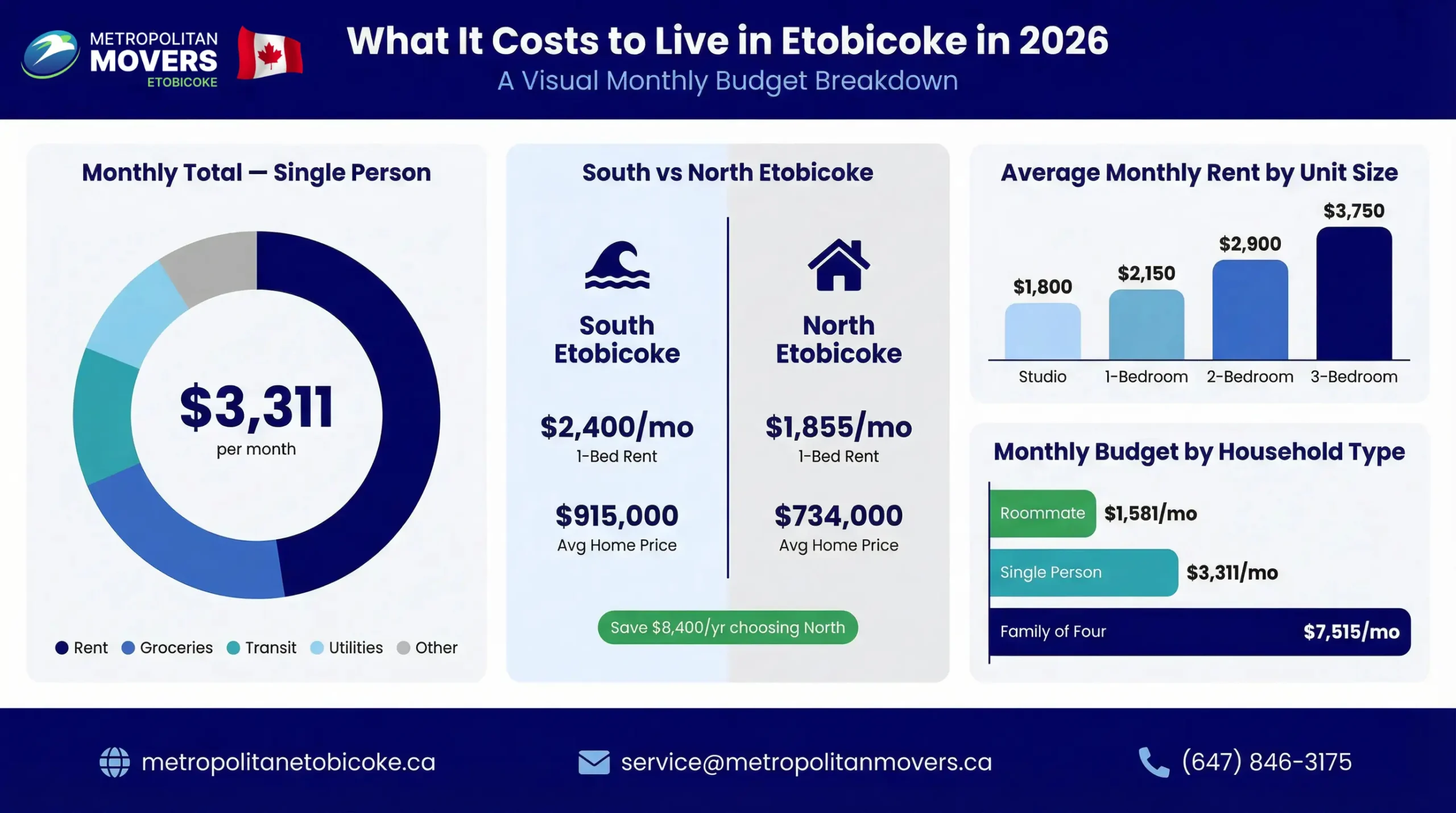
| All Types Combined (West Mall Corridor) | ~$734,000 | Relatively stable |
The Double Land Transfer Tax Factor
One cost that catches many first-time Toronto buyers off guard is the double land transfer tax. Toronto is the only municipality in Ontario that levies its own Municipal Land Transfer Tax (MLTT) on top of the provincial land transfer tax that applies everywhere in the province. Based on the City of Toronto’s published rate schedules, this effectively doubles the tax burden on closing day. City Council has also approved steeper graduated rates on higher-value properties, with changes scheduled to take effect in spring 2026. If your closing date offers any flexibility, it is worth running the numbers on timing. The official rate schedules and calculators are published through the City of Toronto finance department.
When the financial planning is complete and moving day arrives, the physical transition itself should not become a budget surprise. Metropolitan Movers Etobicoke has spent over 15 years helping families and individuals navigate moves across every Etobicoke neighbourhood — from high-rise condos in Humber Bay Shores requiring elevator bookings and loading dock coordination, to detached homes in Markland Wood with basements full of decades of accumulated belongings. Our team handles professional packing for fragile and high-value items as well as safe transport of heavy and oversized furniture.
What Renters Pay: Etobicoke Rent Prices for 1-Bedroom Apartments and Larger Units
Renting is the most common first step for newcomers, young professionals, and anyone testing whether Etobicoke is the right long-term fit before committing to a purchase. Rental pricing data drawn from major Canadian listing aggregators and market reports shows that Etobicoke sits below downtown Toronto’s core pricing but firmly above the national average — reflecting the area’s desirability and its position within Toronto’s municipal boundary.
Current Rental Ranges by Unit Size
Studio apartments in Etobicoke generally fall into a range starting in the mid-$1,400s and stretching toward $2,500 depending on the building, finishes, included amenities, and proximity to a subway station. One-bedroom apartments — the most commonly searched unit type — range from approximately $1,450 at the entry level to around $2,850 for newer construction or waterfront buildings. The typical midpoint for a solid one-bedroom unit in a reasonably maintained mid-rise building sits near the $2,150 mark.
Two-bedroom apartments range from approximately $2,300 to $3,500, while three-bedroom units — which are less common in Etobicoke’s apartment stock and therefore carry a scarcity premium — range from roughly $3,000 to $4,500 per month.
Average listing prices across all unit types in Etobicoke tend to cluster near the $2,670 level, and listings typically spend about five weeks on the market before being leased. Well-priced units in high-demand buildings near Kipling or Islington stations move faster than that average suggests.
| Unit Size | Monthly Rent Range (CAD) | Practical Midpoint |
|---|---|---|
| Studio | $1,450 – $2,500 | ~$1,800 |
| 1-Bedroom | $1,450 – $2,850 | ~$2,150 |
| 2-Bedroom | $2,300 – $3,500 | ~$2,900 |
| 3-Bedroom | $3,000 – $4,500 | ~$3,750 |
Practical Strategies for Reducing Your Monthly Rent
Finding affordable rent in Etobicoke requires strategy, not just scrolling through listings. Here are approaches that consistently yield savings:
- Shared housing and rooms for rent — Splitting a two or three-bedroom unit with a roommate is one of the most effective ways to access desirable neighbourhoods at a fraction of the solo cost; many Etobicoke houses have separate basement entrances that make shared living practical
- Basement apartments — Homeowners across Etobicoke increasingly rent out finished basements to offset their mortgage costs, creating a supply of lower-priced units that rarely appear on major listing platforms; local community groups and neighbourhood boards are often the best source for these
- Distance from subway stations — Buildings directly adjacent to Kipling, Islington, and Royal York stations command a measurable premium; moving even ten to fifteen minutes north by bus drops pricing noticeably
- Pre-1991 buildings — Under Ontario’s Residential Tenancies Act, units in buildings first occupied before November 15, 1991 are subject to the province’s annual rent increase guideline, which caps how much a landlord can raise rent each year
- Winter timing — Rental competition in the GTA drops significantly between November and February; landlords are more open to negotiating on price, offering a free month, or including parking during these slower months
Planning a rental move across Etobicoke or from another part of the GTA? Our local moving service is structured specifically for apartment-to-apartment and house-to-house transitions with transparent pricing and no surprise fees on moving day.
Feeding a Household: Cost of Groceries in Etobicoke
Food expenses represent the second-largest recurring budget category after shelter for most Etobicoke households. The annual Canada Food Price Report — a collaborative research project led by Dalhousie University in partnership with the University of Guelph, the University of Saskatchewan, and the University of British Columbia — projected a further four to six percent increase in food costs for 2026, continuing a multi-year trend of grocery inflation outpacing general consumer price increases.
Translating those national projections into Etobicoke-specific monthly figures, here is what households should realistically budget:
- Single person: $350 to $475 per month, depending on cooking habits, dietary preferences, and willingness to shop at discount chains
- Couple without children: $650 to $825 per month
- Family of four: $1,200 to $1,500 per month — aligning with the Canada Food Price Report’s annualized projection of roughly $16,800 per year for a reference family of four
Etobicoke offers a genuine grocery advantage over many other Toronto districts thanks to its diversity of retail options. Budget-conscious shoppers have access to multiple No Frills and FreshCo locations, mid-range chains like Metro and Loblaws, and a network of independent ethnic grocery stores — particularly along the Albion-Kipling corridor and in the Rexdale area — that offer some of the best-value fresh produce, spices, and protein in the western GTA. Strategic shoppers who rotate between discount chains for staples and ethnic markets for fresh goods can meaningfully undercut the averages listed above.
Keeping the Lights On: Utility Costs in Etobicoke
Utility expenses in Etobicoke are shaped by dwelling type, seasonal demand, and the specific rate structures set by Toronto Hydro (electricity), Enbridge Gas (natural gas), and the City of Toronto (water and solid waste).
Based on current municipal rate structures and the City of Toronto’s approved 2026 budget, here is what to expect:
- Electricity, gas, and water combined (apartment, approximately 85 square metres): $150 to $210 per month, with the lower end reflecting summer months and the upper end reflecting winter heating demand
- Electricity, gas, and water combined (detached home): $225 to $360 per month, with significant winter spikes driven by natural gas heating
- High-speed internet (unlimited, 100+ Mbps): $60 to $85 per month through major Canadian ISPs
- Mobile phone plan (national carrier, data-included): $45 to $80 per month
- Estimated total utilities bundle for an apartment dweller: $260 to $370 per month
- Estimated total utilities bundle for a homeowner (detached): $340 to $520 per month
One detail that frequently catches newcomers off guard: the City of Toronto’s 2026 budget included a 3.75 percent increase in water and solid waste user fees — a rate that actually exceeds the residential property tax increase for the same year. These user fees appear on a separate bill from property taxes but represent a real and growing component of your Etobicoke cost of living 2026 budget. Residents who previously rented with utilities included should pay particular attention to this line item when transitioning to a lease or ownership arrangement where utilities are paid separately.
Getting Around: Transportation Costs in the GTA for Etobicoke Residents
Your monthly transportation costs in Etobicoke will vary enormously depending on whether you rely on public transit, own a vehicle, or combine both. Etobicoke’s geography creates a genuine split: some neighbourhoods sit directly on rapid transit lines, while others remain car-dependent.
Public Transit: TTC Fares, Passes, and the 2026 Fare Cap
The TTC has frozen its base fares for the third consecutive year, meaning adult cash fares, PRESTO fares, and monthly pass prices remain at 2024 levels through 2026. The adult monthly pass sits at $156, while riders who commit to an annual pass through the 12-Month Pass program pay an effective rate of $143 per month. Senior and youth monthly passes are available at $128.15.
A significant development for budget-conscious commuters: the City of Toronto and TTC have confirmed that automatic fare capping will launch in September 2026. Under this system, riders who pay per trip using PRESTO will automatically ride free after reaching 47 trips in a single calendar month — effectively ensuring that no transit rider pays more than the equivalent of a monthly pass, regardless of whether they purchased one in advance. This removes the financial risk of buying a pass during months when you might not use it enough to break even.
Etobicoke’s transit network includes:
- Line 2 (Bloor-Danforth subway) with stations at Kipling, Islington, and Royal York — providing direct east-west rapid transit across the city
- Line 5 (Eglinton Crosstown LRT) — which opened in February 2026, adding a new crosstown rapid transit corridor
- Line 6 (Finch West LRT) — which opened in December 2025, serving northwest Etobicoke and connecting to the Line 1 subway at Finch West station
- GO Transit Lakeshore West line — with stations at Mimico and Long Branch offering express service to Union Station for downtown commuters
- An extensive TTC bus network — covering areas between the subway and LRT corridors
Car Ownership: The Full Monthly Cost
For Etobicoke residents in areas like Rexdale, Thistletown, and certain pockets of south Etobicoke that sit between transit lines, car ownership remains a practical necessity. Based on current Ontario insurance benchmarks, GTA fuel prices, and standard maintenance costs, here is a realistic monthly car ownership budget:
- Auto insurance: approximately $170 per month (based on provincial average annual premiums near $2,045, though individual rates vary significantly by driving history, age, and vehicle)
- Fuel (average commuter driving approximately 1,500 kilometres per month): $150 to $250 per month at current GTA pump prices
- Parking at home (suburban Etobicoke): typically free for houses; $50 to $150 per month for condo or apartment buildings
- Workplace or destination parking: $50 to $200 per month depending on location
- Maintenance and repairs reserve: $100 to $150 per month averaged across the year
- Estimated total car ownership cost: $470 to $770 per month
The gap between a TTC monthly pass ($143 to $156) and full car ownership ($470 to $770) is stark — $3,800 to $7,400 per year in additional spending. For anyone located within reasonable walking or bus distance of a subway station or GO Transit stop, ditching or avoiding car ownership is one of the single largest savings levers available in your Etobicoke cost of living 2026 budget.
What the City Takes: Property Tax Rates in Etobicoke, Ontario
Etobicoke falls under the City of Toronto’s unified property tax framework. Understanding how property taxes actually work in Toronto — including a critical nuance about assessed values — is essential for anyone buying in the area.
How the 2026 Rate Was Set
The City of Toronto’s approved 2026 budget included a combined residential property tax and City Building Fund levy increase of 2.2 percent. Based on the Municipal Property Assessment Corporation’s (MPAC) average current value assessment of a Toronto residential property at approximately $692,000, this translates to an increase of roughly $92 per year, or about $7.63 per month.
This 2.2 percent increase represents a significant deceleration from the steep hikes of 2024 and 2025. The 2024 budget carried a 9.5 percent property tax increase — the largest single-year jump in a quarter century — driven by a massive municipal budget shortfall. The 2025 budget followed with a 6.9 percent increase. While the 2026 figure is much smaller in percentage terms, it is compounding on top of those back-to-back jumps, meaning the cumulative tax burden has grown substantially over the three-year period.
The MPAC Assessment Nuance
Here is a detail that most cost-of-living guides miss entirely: your property tax bill is calculated against your MPAC-assessed value, not your property’s current market value. The province postponed the planned reassessment update that was scheduled to use January 1, 2020 values due to the pandemic, and assessments continue to be based on January 1, 2016 property values. This means that a home currently selling for $1,130,000 on the open market may carry an MPAC assessment of only $550,000 to $650,000 — and your tax bill is calculated on that lower number.
The estimated effective residential tax rate for Toronto in 2026, combining the city levy, education levy, and City Building Fund, sits at approximately 0.66 percent of assessed value. Applying this to realistic MPAC assessments for different Etobicoke property types:
- Condo with MPAC assessment of ~$400,000: approximately $2,640 per year (~$220/month)
- Average house with MPAC assessment of ~$550,000: approximately $3,630 per year (~$303/month)
- Higher-value detached with MPAC assessment of ~$800,000: approximately $5,280 per year (~$440/month)
The Vacant Home Tax: A Separate Obligation
Property owners in Toronto must also account for the Vacant Home Tax (VHT). Under this municipal policy, any residential property that is not occupied as a principal residence for at least six months of the calendar year may be deemed vacant and assessed a tax of three percent of the property’s current value assessment for the 2026 tax year. Critically, every residential property owner must file an annual declaration of occupancy status — even if the property is owner-occupied. The deadline for filing the 2025 occupancy status declaration is April 30, 2026. Failure to file results in the property being automatically deemed vacant and assessed the three percent tax. Full details and filing instructions are available through the City of Toronto’s official Vacant Home Tax page.
Pulling It All Together: Average Monthly Expenses in Etobicoke
With each individual cost category mapped, the real value of this guide is in synthesis. Below is a complete monthly budget framework for three household types in Etobicoke in 2026, based on the cumulative data analyzed throughout this article. These figures align with Statistics Canada’s broader cost-of-living benchmarks for major Canadian urban centres, which place a single person’s monthly needs at roughly $3,000 to $4,000 and a family of four’s at $6,000 to $8,000, depending on location and lifestyle choices.
| Expense Category | Single Person | Couple (No Kids) | Family of Four |
|---|---|---|---|
| Rent / Mortgage Payment | $2,150 | $2,800 | $3,500 |
| Groceries | $400 | $725 | $1,350 |
| Transportation (TTC Pass) | $156 | $312 | $600 |
| Utilities (Hydro, Gas, Water) | $160 | $185 | $250 |
| Internet + Mobile Phone | $120 | $155 | $185 |
| Tenant / Home Insurance | $50 | $75 | $130 |
| Personal, Entertainment & Dining | $275 | $425 | $500 |
| Childcare (if applicable) | — | — | $1,000 |
| ESTIMATED MONTHLY TOTAL | $3,311 | $4,677 | $7,515 |
Important notes on these estimates:
- Figures assume renting, not owning — homeowners should substitute their mortgage payment plus property tax for the rent line
- Transportation assumes TTC transit passes — car owners should replace the TTC line with the $470 to $770 car ownership estimate outlined earlier
- Childcare costs assume one child in licensed daycare; two children would roughly double this line item
- Personal and entertainment spending is moderate and can be adjusted up or down based on lifestyle
How Etobicoke Stacks Up Against Other GTA Alternatives
One of the most common questions from people researching the Etobicoke cost of living 2026 is whether the area delivers genuine value compared to other options within the Greater Toronto Area. The answer depends on what you prioritize.
Compared to Downtown Toronto
Downtown Toronto’s rental market commands a significant premium over the rest of the city, with core neighbourhood rents running roughly 25 to 35 percent higher than comparable units in Etobicoke. A one-bedroom apartment in the Financial District, Entertainment District, or Liberty Village typically ranges from $2,400 to $3,200 per month. Etobicoke’s one-bedroom range of $1,450 to $2,850 means that even at the high end, renters save meaningfully — and at the entry level, the savings can exceed $500 per month. Over a year, that differential alone can cover an entire year’s worth of groceries for a single person.
Compared to Mississauga
Mississauga borders Etobicoke to the west and offers a similar suburban-urban balance. However, crossing the Toronto-Mississauga boundary means leaving the TTC system entirely, entering a different municipal tax jurisdiction, and adjusting to Mississauga Transit or increased reliance on GO Transit. Mississauga’s residential property tax rate is notably higher than Toronto’s — roughly 0.92 percent compared to Toronto’s 0.66 percent — which partially offsets any savings from lower purchase prices. Etobicoke keeps you within Toronto’s municipal boundary with full access to the TTC, City of Toronto services, and the Toronto District School Board.
Compared to North York and Scarborough
Both former municipalities offer competitive alternatives within Toronto. North York’s Yonge Street corridor commands pricing comparable to or exceeding downtown levels, though northern North York neighbourhoods offer better value. Scarborough generally has the lowest rents among Toronto’s former municipalities but offers fewer rapid transit options — a dynamic that is slowly shifting with the Scarborough Subway Extension currently under construction. Etobicoke’s advantage lies in its combination of the Bloor-Danforth subway, two new LRT lines, GO Transit access, and waterfront living options that neither North York nor Scarborough can match.
What Makes Etobicoke Worth the Investment Despite Rising Costs
Etobicoke’s enduring appeal is not accidental. Several structural factors continue to attract residents even as costs climb:
- Waterfront communities with lasting desirability — Mimico, Long Branch, Humber Bay Shores, and the Lakeshore corridor offer water access, recreational trails, and a lifestyle that is genuinely difficult to replicate elsewhere within Toronto’s boundaries
- Family-oriented residential character — Neighbourhoods like The Kingsway, Edenbridge-Humber Valley, Princess-Rosethorn, and Sunnylea feature larger lots, mature tree canopies, established schools, and a sense of residential permanence that attracts families planning long-term stays
- Multi-generational transit investment — The arrival of Lines 5 and 6, continued GO Transit service expansion along the Lakeshore West corridor, and the existing Bloor-Danforth subway stations give Etobicoke a transit network that continues to improve
- Recreational infrastructure — Centennial Park, Humber Bay Park East and West, Marie Curtis Park, and the Humber River trail system provide outdoor recreation and green space that most urban centres cannot match
- Post-secondary institutions — Humber College’s two Etobicoke campuses and the University of Guelph-Humber create a local educational ecosystem that benefits both students and the surrounding community economy
- Neighbourhood diversity and cultural richness — From the South Asian markets along Albion Road to the Italian-Canadian heritage of the Islington Village area, Etobicoke’s multicultural fabric translates directly into food options, community events, and a lived diversity that enriches daily life
Pre-Move Financial Checklist for Etobicoke
Before committing to your relocation, work through this checklist to ensure your budget is complete and your transition is smooth:
- Calculate total shelter costs comprehensively — Rent or mortgage payment plus property tax plus insurance plus all utilities; never use rent alone as your housing budget number
- Research neighbourhood-level pricing carefully — A one-bedroom in Mimico carries a different price tag than the same unit in Rexdale; a detached home in The Kingsway is a different financial commitment than one near the West Mall
- Factor in Toronto’s double land transfer tax if purchasing — This is unique to Toronto and adds thousands to your closing costs above what you would pay anywhere else in Ontario
- Budget for Ontario’s first-and-last-month requirement — The Residential Tenancies Act requires first and last month’s rent upfront for all new lease agreements
- Get a moving estimate before you commit — Lock in your relocation costs with Metropolitan Movers Etobicoke so that moving day is a known line item, not a financial surprise
- Set up your PRESTO card for TTC and GO Transit before your arrival — Registration is available online and saves time during your first week
- Register for OHIP through ServiceOntario as soon as you establish Ontario residency
- Arrange separate utility account transfers — Toronto Hydro, Enbridge Gas, and City of Toronto water each require individual account setup
- Schedule specialty moves early — Items like pianos and large furniture require specialized piano moving equipment and dedicated furniture handling that should be booked well in advance
- File your Vacant Home Tax declaration if you own property in Toronto — Even owner-occupied properties require an annual filing, and missing the deadline triggers an automatic vacant designation with a three percent tax assessment
How Metropolitan Movers Etobicoke Fits Into Your Relocation Budget
Moving costs are a one-time expense, but choosing the wrong provider can turn a single budget line into a financial headache through hidden surcharges, damaged belongings, and last-minute price changes. With over 15 years of experience serving every corner of Etobicoke and the broader GTA, Metropolitan Movers Etobicoke operates on a transparent pricing model that eliminates surprises.
Our services map directly to how real people actually move:
- Local moves within Etobicoke and the GTA — Flat-rate and hourly options for apartment-to-apartment, house-to-house, and condo-to-house transitions
- Long-distance relocations across Ontario and beyond — Dedicated trucks with scheduled delivery windows for interprovincial moves
- Full-service professional packing — Expert packing using industry-grade materials for fragile, oversized, and high-value items
- Specialty item transport — Piano moving and heavy furniture removals with the equipment these items demand
- Moves across the Toronto area — City-wide Toronto routes including downtown-to-Etobicoke and Etobicoke-to-suburbs
Every quote is customized to your specific situation. A studio in a Humber Bay Shores high-rise — with elevator booking requirements, loading dock scheduling, and narrow hallway navigation — requires a completely different approach than a four-bedroom detached home in Markland Wood with a long driveway, a packed garage, and a basement full of storage. We assess your move individually and provide an honest, fixed number before moving day.
The Affordability Verdict: Is Etobicoke a Smart Financial Move in 2026?
The straightforward answer: the Etobicoke cost of living 2026 is not cheap. Ontario and British Columbia remain Canada’s most expensive provinces, driven primarily by the housing markets in Toronto and Vancouver. Within that expensive context, Etobicoke carves out a meaningful middle ground.
Single professionals can live a solid quality of life on $3,300 to $3,800 per month. Couples without children should plan for $4,500 to $5,000. Families of four need a combined household income that comfortably supports $7,500 to $8,500 in monthly expenses.
The real question is not whether Etobicoke is expensive — it is — but whether the value equation aligns with your priorities. If you need proximity to downtown Toronto without paying downtown prices, access to both subway and GO Transit, green space and waterfront trails, family-friendly neighbourhoods with strong schools, and a range of housing types spanning from starter condos to estate homes, Etobicoke delivers across every one of those dimensions.
Plan your numbers carefully, build your budget conservatively, and make the move with the confidence that comes from knowing exactly what you are walking into. And when the time comes to physically relocate, Metropolitan Movers Etobicoke is here to ensure that the transition itself is one cost that stays firmly within your control.
Frequently Asked Questions About Etobicoke’s Cost of Living
What is the average monthly cost of living for a single person in Etobicoke in 2026?
Based on current rental pricing, grocery costs, TTC transit fares, utility rates, and moderate personal spending, a single person living in Etobicoke should budget between $3,300 and $3,800 per month. The largest component is rent, which typically falls between $1,450 and $2,850 for a one-bedroom apartment depending on the building and neighbourhood. Transit riders using a monthly TTC pass spend $156 per month on commuting, while car owners face a significantly higher transportation burden of $470 to $770 per month.
How much does a one-bedroom apartment cost to rent in Etobicoke?
One-bedroom apartments in Etobicoke range from approximately $1,450 to $2,850 per month as of spring 2026, with the practical midpoint for a well-maintained unit sitting near $2,150. Proximity to subway stations (Kipling, Islington, Royal York), building age, included amenities, and parking availability all influence where within that range a specific unit falls. Newer waterfront buildings in Mimico and Humber Bay Shores tend to command the higher end.
Are groceries expensive in Etobicoke compared to the rest of Canada?
Grocery prices in Etobicoke are in line with broader GTA pricing, which runs somewhat higher than the national average. The Canada Food Price Report produced by Dalhousie University projected a four to six percent increase in food costs for 2026 nationally. A single person should budget $350 to $475 per month for groceries, while a family of four should plan for $1,200 to $1,500 per month. Strategic use of discount grocery chains like No Frills and FreshCo, combined with ethnic markets in the Albion-Kipling area, can help keep costs toward the lower end of those ranges.
What are property tax rates in Etobicoke for 2026?
Etobicoke uses the City of Toronto’s residential property tax rate, which for 2026 works out to approximately 0.66 percent of your MPAC-assessed property value. A critical detail: Toronto property taxes are currently calculated on January 1, 2016 assessed values, not current market values. This means your tax base is substantially lower than what your home would sell for today. The 2026 budget approved a 2.2 percent combined increase in the residential property tax and City Building Fund levy.
How much does it cost to ride the TTC in Etobicoke?
A single adult PRESTO fare on the TTC is $3.35. The adult monthly pass costs $156, and riders who commit to the 12-Month Pass program pay an effective rate of $143 per month. Starting in September 2026, the TTC will introduce automatic fare capping, meaning that riders who pay per trip will automatically ride free after 47 trips in a calendar month — ensuring no one spends more than the monthly pass equivalent.
Is Etobicoke cheaper than downtown Toronto?
Yes, meaningfully so. Rental pricing in Etobicoke runs approximately 15 to 30 percent below comparable units in Toronto’s downtown core. A one-bedroom downtown typically costs $2,400 to $3,200, while the Etobicoke range starts at $1,450. Grocery costs are roughly comparable, but the availability of discount chains and ethnic markets in Etobicoke can give budget-conscious shoppers an edge. Property tax rates are the same across Toronto, but Etobicoke’s lower average MPAC assessments compared to downtown result in lower absolute tax bills for similarly priced properties.
What should a family of four budget per month in Etobicoke?
A family of four renting a three-bedroom apartment or modestly sized house in Etobicoke should budget approximately $7,500 to $8,500 per month in total expenses. This includes shelter ($3,500), groceries ($1,350), transportation ($600 for a combination of transit and occasional car use), utilities ($250), internet and mobile ($185), insurance ($130), personal and entertainment spending ($500), and childcare for one child ($1,000). Families with two children in daycare should add an additional $800 to $1,000 to the childcare line.
When is the cheapest time to move to Etobicoke?
The rental market in the GTA is most competitive during summer months (June through September), when demand peaks from students, new graduates, and families wanting to settle before the school year. Moving during the winter months — November through February — typically yields better rental pricing, more negotiating leverage with landlords, and lower demand for moving services. If your timeline is flexible, a winter move can save money on both rent and relocation costs.
Does Etobicoke have good public transit access?
Etobicoke has strong public transit in certain corridors and weaker coverage in others. The Bloor-Danforth subway (Line 2) serves Kipling, Islington, and Royal York stations. GO Transit’s Lakeshore West line stops at Mimico and Long Branch. Two new LRT lines — Line 5 Eglinton (opened February 2026) and Line 6 Finch West (opened December 2025) — have expanded rapid transit connectivity. However, areas like Rexdale, Thistletown, and parts of central Etobicoke between these corridors remain primarily served by bus routes, which can make commute times longer and car ownership more practical.
What is the Vacant Home Tax and does it affect Etobicoke homeowners?
The Vacant Home Tax is a City of Toronto policy that applies to all residential properties across the city, including Etobicoke. Any property that is not occupied as a principal residence for at least six months of the year may be assessed a tax of three percent of its current value assessment. Every property owner — including those whose homes are fully occupied — must file an annual declaration of occupancy status with the City. The deadline for the 2025 occupancy year declaration is April 30, 2026. Failing to file automatically results in the property being deemed vacant and subject to the three percent tax.