
Understanding closing costs for buying a home in Etobicoke prevents the sticker shock that catches many first-time buyers unprepared when purchase agreements transition to actual ownership transfers. Beyond the down payment and mortgage approval, buyers face a cascade of fees, taxes, insurance premiums, and professional service charges that accumulate during the weeks between offer acceptance and keys-in-hand possession. These closing costs for buying a home in Etobicoke typically total between one point five and four percent of the purchase price depending on property value, mortgage structure, and whether buyers qualify for any available rebates or exemptions. Whether you are a first-time buyer navigating the Toronto real estate market, a move-up purchaser familiar with the process, or an investor acquiring rental property, accurately budgeting for closing costs for buying a home in Etobicoke ensures your financial planning accounts for the complete transaction expense rather than treating the purchase price as the total investment required.
This comprehensive guide breaks down every category of closing costs for buying a home in Etobicoke including land transfer taxes at both municipal and provincial levels, legal fees and disbursements, home inspection expenses, title insurance premiums, mortgage-related costs, property tax adjustments, and miscellaneous closing day expenses. For complete cost-of-living analysis including ongoing ownership expenses beyond just purchase closing costs, the Etobicoke cost of living 2026 guide provides comprehensive financial planning frameworks. For buyers coordinating home purchases with relocation timelines, Metropolitan Movers Etobicoke synchronizes moving services with possession dates across all Etobicoke neighbourhoods.
Why Closing Costs for Buying a Home in Etobicoke Require Separate Budget Planning
Closing costs for buying a home in Etobicoke require separate budget planning because they fall due at or shortly before closing date, creating a concentrated cash outflow beyond the down payment that many buyers fail to anticipate adequately. First-time buyers particularly underestimate these costs, assuming mortgage pre-approval and down payment savings represent complete financial readiness when substantial additional cash requirements remain.
The timing of closing costs creates liquidity challenges because buyers cannot finance these expenses through their primary mortgage in most cases, requiring separate savings or supplementary financing arrangements. Buyers who allocate all available cash to maximize down payments discover they lack funds for closing costs, forcing last-minute scrambles for family loans, withdrawal from retirement accounts, or acceptance of higher-interest supplementary mortgages to bridge the gap.
The complexity of closing costs for buying a home in Etobicoke stems from the variety of parties and purposes these payments serve. Provincial and municipal governments collect land transfer taxes. Lawyers charge fees for legal services and disbursements. Inspectors require payment for property condition assessments. Title insurers levy premiums for ownership protection. Lenders impose various mortgage setup fees. Each category operates independently with separate payment timelines and requirements, creating coordination challenges that professional real estate lawyers manage but that buyers must ultimately fund.
Metropolitan Movers Etobicoke frequently coordinates with buyers whose possession dates shift due to closing cost complications, understanding that financial planning gaps create moving timeline adjustments requiring flexible service scheduling.
Land Transfer Tax in Toronto: The Largest Single Closing Cost Component
Land transfer tax represents the largest single closing cost for buying a home in Etobicoke due to Toronto’s municipal land transfer tax layering on top of Ontario’s provincial tax, creating a double tax burden unique to Toronto among GTA municipalities. This dual taxation structure means Etobicoke home buyers pay significantly more in transfer taxes than purchasers in neighbouring Mississauga, Vaughan, or other non-Toronto municipalities where only provincial tax applies.
The provincial land transfer tax applies across Ontario using a marginal rate structure that increases with property value. Lower-value properties face lower tax rates while higher-value purchases trigger progressively higher rates on the portions of purchase price exceeding various thresholds. This progressive structure means that closing costs for buying a home in Etobicoke scale proportionally with property value rather than representing fixed amounts.
Toronto’s municipal land transfer tax mirrors the provincial structure but adds a second complete calculation on top of provincial obligations. The combined provincial and municipal land transfer tax burden makes this expense category the dominant closing cost component for most Etobicoke home purchases, often exceeding all other closing costs combined for properties above certain value thresholds.
First-time home buyers benefit from rebates on both provincial and Toronto land transfer taxes, providing substantial savings that materially reduce total closing costs for buying a home in Etobicoke for qualifying purchasers. These rebates eliminate or reduce land transfer tax obligations for eligible buyers, though maximum rebate amounts cap the benefit meaning higher-value properties still generate significant tax liabilities even after rebate application.
The Etobicoke cost of living 2026 guide provides detailed analysis of how land transfer tax obligations factor into total home ownership costs across different Etobicoke neighbourhoods and property price points.
Legal Fees and Disbursements: Professional Services Required for Closing
Legal fees represent essential closing costs for buying a home in Etobicoke because Ontario real estate transactions require lawyer involvement to ensure proper title transfer, mortgage registration, and compliance with regulatory requirements protecting both buyers and lenders. Real estate lawyers charge fees for their professional services alongside disbursements covering third-party costs they incur on buyers’ behalf during transaction processing.
Professional legal fees compensate lawyers for reviewing purchase agreements, conducting title searches, preparing and registering transfer documents, arranging title insurance, reviewing mortgage terms, managing trust account transactions, and coordinating closing day procedures. The complexity of Etobicoke real estate transactions involving Toronto’s regulatory environment, potential property tax complications, and occasionally complex title histories justifies legal expertise that prevents costly mistakes amateur handling might create.
Disbursements represent actual costs lawyers pay to third parties then recover from buyers including title search fees, registration charges, courier expenses, and various government filing fees required for legal title transfer and mortgage registration. These disbursements accumulate across the transaction timeline as lawyers order searches, register documents, and comply with regulatory requirements mandating various payments to government registries and service providers.
Real estate lawyers in Etobicoke operate in competitive markets with fee structures varying based on transaction complexity, property value, and whether the lawyer handles both purchase and mortgage or just one component. Buyers should obtain fee quotes from multiple lawyers comparing both professional fees and estimated disbursements to understand total legal costs before committing to representation.
For buyers evaluating total Etobicoke homeownership costs beyond just closing expenses, the best neighborhoods in Etobicoke guide provides comprehensive financial analysis across areas.
Home Inspection Fees: Essential Due Diligence Investment
Home inspection fees constitute prudent closing costs for buying a home in Etobicoke despite being optional rather than mandatory expenses. Professional home inspectors assess property condition, identify defects, evaluate system functionality, and provide detailed reports informing buyers about maintenance requirements, safety issues, and potential future expenses before purchase completion.
The inspection process involves comprehensive property examination including structural components, roofing, electrical systems, plumbing, HVAC equipment, foundation, and visible interior and exterior elements. Inspectors document current condition, identify code violations, flag safety hazards, and estimate remaining useful life for major systems and components requiring eventual replacement.
Inspection timing matters because buyers typically negotiate inspection contingencies into purchase agreements allowing deal cancellation or renegotiation if inspections reveal material defects unknown at offer acceptance. This contingency protection provides buyers with information leverage and exit options that justify inspection costs even when inspections ultimately reveal no significant issues requiring price adjustments.
Specialized inspections beyond standard whole-house assessments may prove necessary for older Etobicoke properties including separate evaluations for mold, asbestos, lead paint, structural engineering, or environmental contamination. These specialized assessments add to closing costs for buying a home in Etobicoke but prevent catastrophic post-purchase discoveries requiring expensive remediation that buyers cannot afford.
Buyers who skip inspections to save costs or strengthen offers in competitive markets accept significant risk that unknown defects will generate expenses exceeding the inspection fees saved. The peace of mind and negotiating power inspections provide typically justify the expense for all but the most budget-constrained or risk-tolerant purchasers.
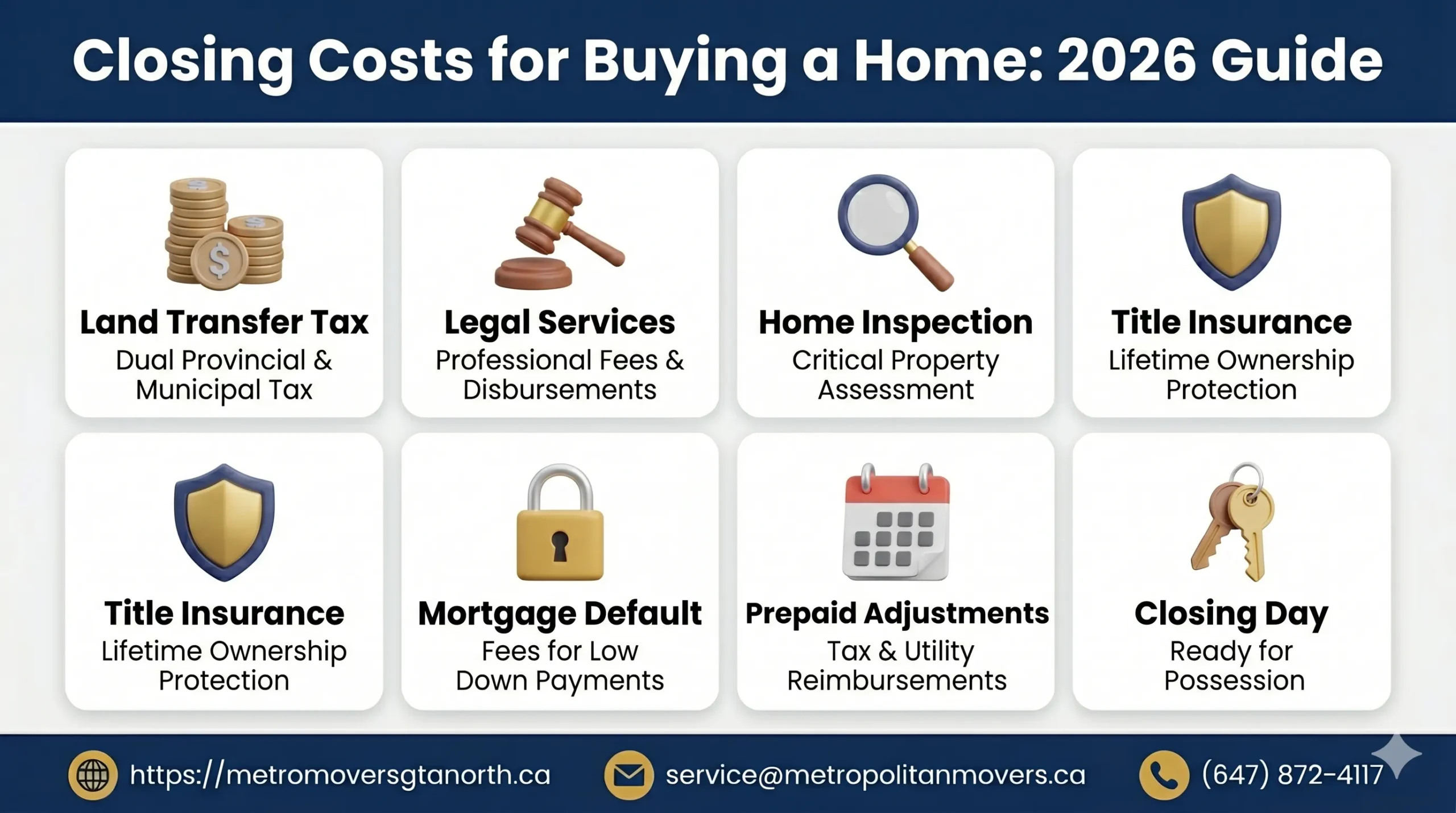
Closing Costs for Buying a Home in Etobicoke: Complete Category Breakdown
| Cost Category | Purpose | Payment Timing | Notes |
|---|---|---|---|
| Land Transfer Tax (Provincial + Toronto) | Government tax on property ownership transfer | Due on closing day | Usually largest single closing cost; first-time buyer rebates available |
| Legal Fees & Disbursements | Lawyer services for title transfer and document registration | Due on or before closing | Includes professional fees plus third-party charges |
| Home Inspection | Property condition assessment | Due at inspection completion | Optional but strongly recommended; paid before closing |
| Title Insurance | Protection against title defects and ownership disputes | Due on closing day | One-time premium for lifetime coverage |
| Mortgage Default Insurance (if applicable) | Required for down payments under twenty percent | Added to mortgage or paid at closing | Significant cost for buyers with smaller down payments |
| Property Tax Adjustment | Reimburse seller for prepaid property taxes | Calculated at closing | Amount varies by closing date within tax year |
| Appraisal Fee (if required) | Property valuation for mortgage approval | Due at appraisal completion | Some lenders waive; others charge buyer directly |
| Utility Connection & Deposits | Establish accounts for hydro, gas, water | Required before/at possession | Deposits required for new customers without credit history |
| Closing costs for buying a home in Etobicoke vary by property value, mortgage structure, and buyer qualifications. Consult with real estate lawyers and mortgage professionals for accurate estimates based on specific circumstances. | |||
Title Insurance: Protection Against Hidden Ownership Issues
Title insurance constitutes essential closing costs for buying a home in Etobicoke providing protection against title defects, ownership disputes, encroachments, zoning violations, and other issues that title searches may fail to uncover before purchase completion. This one-time premium purchases lifetime coverage protecting buyers and their heirs from financial losses arising from title problems discovered after closing.
The title insurance process involves insurers reviewing title search results, assessing risk factors, and issuing policies guaranteeing compensation if covered title defects emerge requiring legal defense or causing ownership loss. Common issues title insurance addresses include fraudulent prior transfers, forged documents, undisclosed easements, municipal work orders, and zoning compliance violations that escaped detection during pre-closing title examination.
Lender policies protect mortgage holders while owner policies protect buyers directly. Most Etobicoke transactions involve both policy types with buyers typically paying premiums for both coverages as part of closing costs. The combined premium represents a modest percentage of property value but provides substantial protection against potentially catastrophic title failures that could render properties unsaleable or generate expensive legal battles.
Title insurance eliminates the need for expensive legal opinions on title that Ontario formerly required, providing coverage efficiency that reduced overall transaction costs despite adding the insurance premium to closing expenses. The streamlined process and risk transfer justify the premium for the vast majority of Etobicoke home buyers.
Mortgage Insurance and Related Financing Costs
Mortgage insurance represents significant closing costs for buying a home in Etobicoke when buyers make down payments below twenty percent of purchase price, triggering mandatory default insurance requirements protecting lenders against borrower default risk. This insurance premium can be added to mortgage principal and paid over the amortization period or paid upfront at closing depending on buyer preferences and lender requirements.
The insurance premium structure scales with down payment size, charging higher premiums for smaller down payments reflecting increased lender risk when buyers have minimal equity. The premium percentage of the mortgage amount decreases as down payment percentage increases, rewarding buyers who contribute larger down payments with lower insurance costs.
Lenders may also charge mortgage setup fees, appraisal charges, and administration costs as part of closing costs for buying a home in Etobicoke. These lender fees vary significantly across institutions with some lenders absorbing costs as competitive differentiators while others pass all charges to borrowers. Buyers should compare total lending costs across lenders rather than focusing solely on interest rates when evaluating mortgage options.
Pre-payment penalties from existing mortgages apply when buyers sell properties with remaining mortgage balances, though these penalties affect sellers rather than buyers directly. However, buyers assuming existing mortgages or arranging vendor-take-back financing face unique cost structures requiring careful analysis with legal and financial advisors.
The Etobicoke cost of living 2026 guide analyzes total housing costs including ongoing mortgage payments, property taxes, and maintenance expenses beyond just initial closing costs.
Property Tax Adjustments and Prepaid Expense Reimbursements
Property tax adjustments constitute routine closing costs for buying a home in Etobicoke requiring buyers to reimburse sellers for property taxes paid covering the period after closing when buyers rather than sellers will own and occupy properties. Toronto property tax billing cycles create timing mismatches between tax payment dates and property transfer dates, necessitating pro-rated adjustments calculated at closing.
The adjustment calculation involves determining the daily property tax amount based on annual tax bills, counting days between closing and the next tax billing date, and computing reimbursement amounts buyers owe sellers for this interim period. Lawyers handle these calculations as part of closing statement preparation, ensuring accurate adjustments that account for actual tax bills rather than estimates.
Similar adjustments may apply for prepaid utilities, condo fees, rental equipment, or other expenses sellers paid extending beyond closing dates. Buyers should budget for these adjustments as part of closing costs recognizing that timing of various payment cycles affects total cash required at closing even though amounts typically remain modest relative to other cost categories.
The reverse situation occurs when sellers owe property taxes for periods prior to closing but haven’t yet paid. In these cases, credits flow from sellers to buyers reducing total closing costs. The direction and magnitude of property tax adjustments depend entirely on closing date timing within annual tax cycles.
Budgeting Strategy for Total Closing Costs
Effective budgeting strategy for closing costs for buying a home in Etobicoke begins during initial home affordability analysis rather than after purchase agreements are signed. Buyers should estimate total closing costs as percentage of purchase price based on their specific situations including first-time buyer status, down payment size, property value, and other factors affecting individual cost components.
Conservative buyers budget toward the higher end of estimated closing cost ranges to ensure adequate liquidity for closing without requiring last-minute financing arrangements that may carry unfavorable terms. The financial cushion protects against estimate errors, unexpected additional costs discovered during due diligence, or timing issues requiring buyers to carry additional expenses beyond original projections.
Coordination between down payment savings and closing cost reserves ensures buyers maintain adequate total liquidity for complete transaction costs plus post-closing cash reserves for immediate property needs, moving expenses, and furnishing costs that arise after possession. Buyers who drain all savings for down payment and closing costs leave themselves financially vulnerable to unexpected repairs, job disruptions, or other challenges requiring cash reserves.
Metropolitan Movers Etobicoke frequently works with buyers who underbudgeted for total relocation costs including both closing costs and moving expenses, creating financial stress during what should be an exciting transition. The Etobicoke cost of living 2026 guide provides comprehensive financial planning frameworks accounting for all relocation expenses.
How Closing Costs Vary Across Etobicoke Neighbourhoods
While closing costs for buying a home in Etobicoke follow consistent formulas and fee structures, the absolute amounts vary across neighbourhoods based primarily on property values which drive land transfer taxes and many other costs calculated as percentages of purchase price. Higher-value neighbourhoods like The Kingsway or Baby Point generate substantially higher closing costs than more affordable areas like Rexdale or portions of south Etobicoke.
Property tax adjustments also vary across Etobicoke reflecting different assessed values and tax rates affecting reimbursement calculations at closing. Newer developments may carry development charges or levies that older neighbourhoods avoid, creating neighbourhood-specific closing costs beyond standard categories.
Condo purchases involve additional closing costs including status certificate fees, condo lawyer review charges, and sometimes special assessment obligations that detached home purchases avoid. The concentration of condo inventory in areas like Humber Bay Shores or near Kipling Station creates neighbourhood patterns in closing cost structures reflecting property type distributions.
For neighbourhood-specific cost analysis, the south Etobicoke vs north Etobicoke cost comparison breaks down financial considerations across the borough’s geographic divisions.
Coordinating Home Purchases With Moving Logistics
Coordinating closing costs for buying a home in Etobicoke with moving logistics requires financial planning that budgets for both transaction expenses and relocation costs as integrated components of total move expense. Buyers who drain savings for closing costs then face moving expenses without adequate reserves, while those who budget comprehensively manage both components smoothly.
Metropolitan Movers Etobicoke provides residential moving services coordinated with closing dates across all Etobicoke neighbourhoods. The moving to Etobicoke guide covers relocation planning beyond just financial considerations.
For buyers requiring storage between sale closing and purchase possession, separate budgeting ensures adequate funds for this interim need. The Etobicoke cost of living 2026 guide provides the complete financial framework for home purchase and relocation planning.
When ready to finalize your Etobicoke home purchase and coordinate your relocation, Metropolitan Movers Etobicoke synchronizes moving services with possession timelines. Explore the full services page or contact the team to begin planning.