
Moving to Alderwood places you in one of south Etobicoke’s most underrated residential pockets, where quiet tree-lined streets, proximity to Sherway Gardens shopping, access to Lake Ontario waterfront, and solid public schools combine to create a neighbourhood that delivers suburban comfort within Toronto city limits. Situated between Browns Line and Kipling Avenue south of the Gardiner Expressway, Alderwood remains relatively unknown outside long-time Etobicoke residents despite offering the combination of affordability, convenience, and community character that families actively seek when relocating to Toronto’s western borough. Whether you are downsizing from north Etobicoke, upgrading from a condo, or arriving from another GTA municipality, moving to Alderwood provides the neighbourhood stability, walkable amenities, and quality-of-life balance that makes home ownership genuinely satisfying rather than merely functional.
This local guide covers everything families need to know about moving to Alderwood including real estate market conditions, transit and commute options, school catchments, parks and recreation, shopping access through Sherway Gardens, and the distinct community vibe that sets this pocket apart from surrounding south Etobicoke areas. For comprehensive cost analysis comparing Alderwood to other Etobicoke neighbourhoods, the Etobicoke cost of living 2026 guide provides detailed financial breakdowns. For families ready to coordinate their Alderwood relocation, Metropolitan Movers Etobicoke handles every operational detail from packing through final placement.
Why Moving to Alderwood Deserves Serious Consideration
Moving to Alderwood deserves attention from families and professionals seeking affordable Etobicoke home ownership because the neighbourhood delivers value that more prominent areas like Mimico and Long Branch command premium pricing to access. Detached homes in Alderwood trade at price points ten to twenty percent below comparable properties in trendier south Etobicoke pockets, yet residents enjoy equivalent or superior access to Sherway Gardens, similar school quality, and identical proximity to Lake Ontario waterfront trails and parks.
The neighbourhood’s relative anonymity works to buyers’ advantage during housing searches, as properties receive less competition than listings in neighbourhoods featured in Toronto real estate marketing and media coverage. This reduced buyer competition creates negotiating leverage and acquisition opportunities that vanish in higher-profile areas where multiple offers and bidding wars compress value for purchasers.
Alderwood’s established character means housing stock primarily consists of post-war detached homes, bungalows, and side-split configurations built between the 1950s and 1980s with mature landscaping, finished basements generating rental income potential, and lot sizes exceeding newer suburban developments. Families moving to Alderwood from condos or townhomes gain yards, garage space, and storage capacity that supports growing households and active lifestyles suburban apartments cannot accommodate.
For comparative analysis positioning Alderwood against other south Etobicoke options, the best neighborhoods in Etobicoke guide provides side-by-side comparisons across factors including cost, amenities, and schools.
Alderwood Real Estate: What Your Budget Buys in This Market
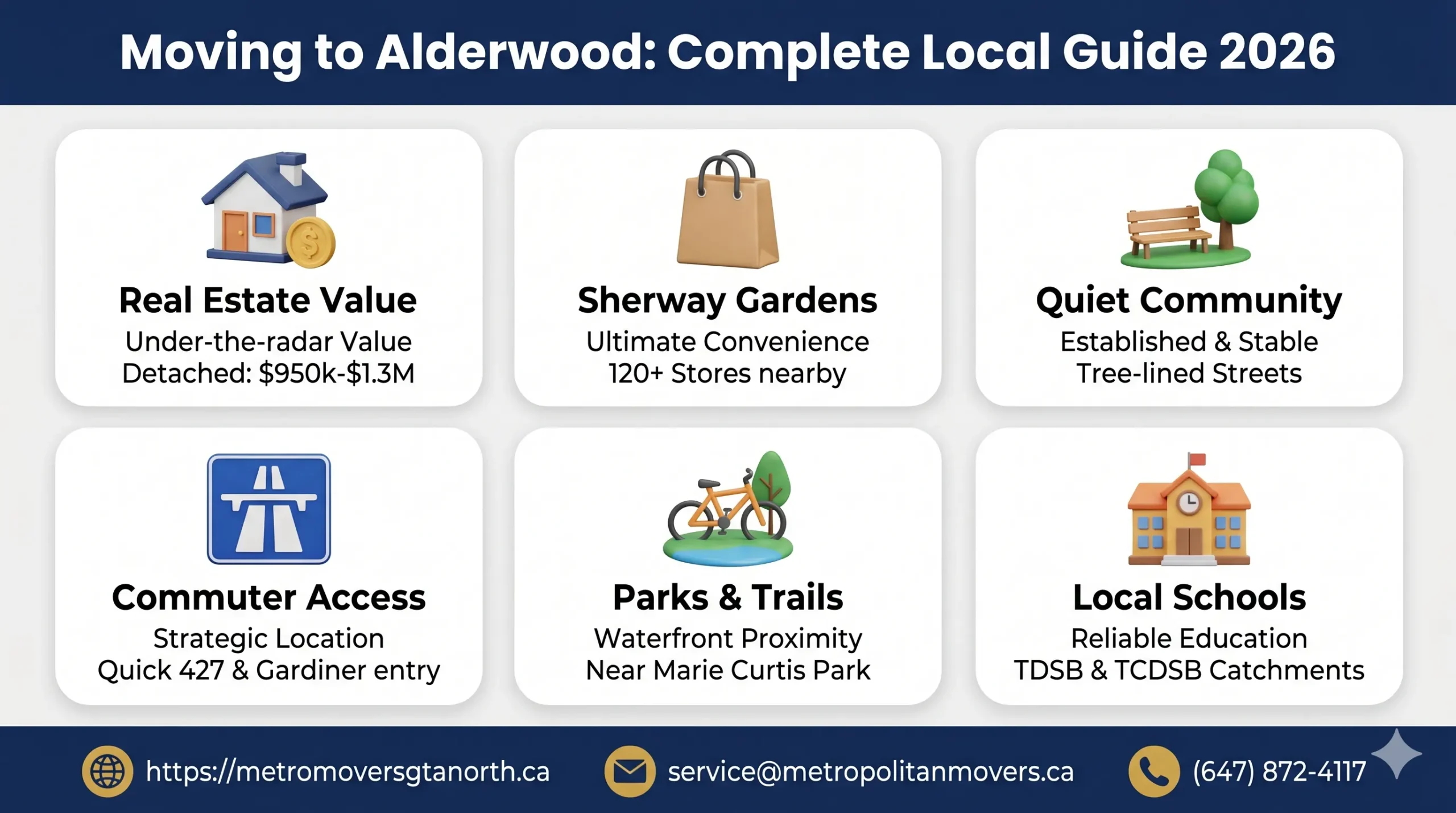
Alderwood real estate in 2026 operates in a buyers’ market transitioning toward balance following the correction that compressed prices from 2022 peak levels. Detached homes in Alderwood trade in the range of nine hundred fifty thousand to one point three million dollars depending on lot size, condition, and specific street location. Bungalows with finished basements generating rental income potential sit at the lower end of this range, while larger side-split and two-storey homes on premium lots command pricing above one million.
Semi-detached properties and townhomes provide entry points for first-time buyers and households prioritizing Alderwood location over detached home ownership, with pricing running from six hundred fifty thousand to eight hundred fifty thousand for move-in ready units. These property types generate strong rental demand from families seeking Alderwood school access and Sherway Gardens proximity without committing to detached home ownership costs.
Rental market conditions in Alderwood reflect broader south Etobicoke dynamics with two-bedroom units renting for two thousand to two thousand four hundred monthly and three-bedroom homes commanding two thousand six hundred to three thousand two hundred depending on finishes and basement inclusion. Basement apartments in Alderwood detached homes rent separately for thirteen hundred to seventeen hundred monthly, providing investment income for homeowners and affordable housing options for renters.
Property tax rates in Alderwood follow Toronto’s municipal tax structure running approximately zero point six six percent of assessed value annually, creating lower tax burdens than neighbouring Mississauga despite higher absolute home values in many cases. Families moving to Alderwood should factor this tax advantage into total ownership cost calculations when comparing Toronto neighbourhoods to Peel Region alternatives.
The Etobicoke cost of living 2026 guide provides detailed housing cost analysis across all Etobicoke neighbourhoods including Alderwood, while the cheapest places to live in Etobicoke resource identifies the most affordable pockets for budget-conscious buyers.
Sherway Gardens Access: Alderwood’s Defining Convenience Factor
Sherway Gardens access defines Alderwood’s value proposition for families prioritizing shopping convenience, dining options, and service access within short driving or even walking distance from home. The mall sits immediately north of Alderwood along Highway 427, providing one hundred twenty-plus stores including Hudson’s Bay, Nordstrom, Apple, and full-service dining ranging from casual chains to sit-down restaurants that eliminate the need to travel downtown or to Yorkdale for shopping and entertainment.
Beyond retail convenience, Sherway Gardens functions as a de facto community centre for Alderwood residents through its climate-controlled walking space during winter months, food court serving as casual meeting spot, and programming including seasonal events and farmer’s markets activating the property beyond pure retail transactions. Seniors moving to Alderwood frequently cite Sherway Gardens mall walking as daily exercise during cold weather, while families with young children use the mall as a rainy-day destination when outdoor play proves impossible.
The mall’s Highway 427 positioning creates vehicle access from Alderwood in under five minutes via Browns Line or Kipling Avenue, while TTC bus routes connect the neighbourhood to Sherway Gardens for residents without vehicles or seniors who have stopped driving. This transit connectivity ensures Sherway Gardens remains accessible even as household mobility changes with aging.
Proximity to Sherway Gardens also positions Alderwood residents near big-box retail along The Queensway and employment nodes around the mall supporting service sector jobs accessible without lengthy commutes. Families with teenagers seeking part-time work or adults in retail, hospitality, or service industries benefit from immediate job access that reduces commute time and transportation costs.
For families evaluating how Sherway Gardens access compares to amenities in other Etobicoke areas, the family-friendly neighborhoods in Etobicoke guide maps shopping, recreation, and service access across the borough.
Alderwood Community Vibe: Established, Quiet, Genuinely Neighbourly
Alderwood community vibe reflects its established residential character where many households have lived for decades, children have grown up knowing neighbours, and the pace of change runs slower than trendy areas experiencing rapid demographic shifts and property turnover. This stability creates a neighbourhood where residents recognize each other on streets, participate in block parties and community events, and maintain the kind of casual social connections that define traditional suburban neighbourhoods before digital isolation became normative.
The community’s demographic profile skews toward families with school-age children, empty nesters aging in place, and young families purchasing starter homes from original owners downsizing or moving to retirement communities. This generational mix provides natural community mentorship where established residents welcome newcomers, share neighbourhood knowledge, and maintain the social fabric that makes moving to Alderwood feel like joining a community rather than simply occupying a property.
Alderwood’s quiet character stems from limited through-traffic due to street patterns that serve local residents rather than functioning as shortcuts between major roads. Most streets dead-end or curve back on themselves, eliminating the commuter traffic that disrupts residential tranquility in neighbourhoods with grid patterns connecting arterials. This traffic calming through design rather than enforcement creates safe streets for children playing, seniors walking, and cyclists navigating without constant vehicle presence.
The neighbourhood’s modest profile compared to higher-profile Etobicoke areas like Mimico or areas along the Bloor West Village corridor means Alderwood residents prioritize substance over status, valuing functional homes, good schools, and community connection rather than fashionable addresses or investment speculation. This orientation creates stable, family-focused character that appeals to households seeking genuine neighbourhood life rather than transient rental-dominated areas.
Alderwood Transit and Commute Realities
Alderwood transit options through TTC bus routes provide functional but not exceptional connectivity to Toronto’s broader transit network and employment centres. Bus service along Browns Line, Kipling Avenue, and The Queensway connects Alderwood to Kipling subway station on Line 2, creating transit pathways to downtown Toronto for residents willing to accept transfer-based commutes running sixty to seventy-five minutes door-to-door during peak periods.
Direct subway access does not exist from Alderwood, requiring bus connections that limit transit appeal for downtown commuters compared to neighbourhoods along subway corridors. However, this transit limitation positions Alderwood as car-oriented suburban living where most households operate vehicles for commuting, errands, and recreation rather than depending on public transit for daily mobility.
GO Transit access through Long Branch and Mimico GO stations south of Alderwood provides express rail service to Union Station for residents willing to drive or bus to these stations. This GO Transit option delivers faster downtown commutes than TTC bus-to-subway transfers, though the need to reach GO stations first creates multi-modal trip complexity that many commuters find cumbersome compared to single-seat subway rides from other areas.
Highway access via the Gardiner Expressway and Highway 427 positions Alderwood residents for vehicle commutes to downtown Toronto, airport area employment, and Mississauga job centres with trip times running thirty to sixty minutes depending on destination and departure timing. Families with employment outside downtown Toronto often find Alderwood’s highway access superior to transit-dependent neighbourhoods where commutes to suburban employment nodes prove difficult without vehicles.
The Etobicoke cost of living 2026 guide factors transportation costs including vehicle ownership and transit passes into total cost analysis by neighbourhood, helping families understand true commute expenses beyond housing costs alone.
Parks and Recreation in Alderwood: Green Space Access
Parks in Alderwood include neighbourhood-scale facilities serving local residents alongside proximity to larger regional parks and Lake Ontario waterfront trails accessible within short drives or bike rides. Alderwood Park operates as the neighbourhood’s primary green space featuring sports fields, playgrounds, and open lawn space supporting informal recreation, though the park’s modest size limits programming compared to major Etobicoke facilities like Centennial Park or James Gardens.
Immediate waterfront access through Marie Curtis Park and Etobicoke’s lakefront trail network positions Alderwood residents within cycling or short driving distance of extensive trail systems, beach access, and waterfront recreation that defines south Etobicoke’s quality of life appeal. Families prioritizing outdoor activity, cycling, and nature access benefit from this proximity despite Alderwood’s inland position away from the immediate lakefront.
Recreation centres serving Alderwood include South Etobicoke facilities offering swimming pools, arenas, fitness centres, and programming for children and seniors. While Alderwood itself does not contain major recreation infrastructure, the neighbourhood’s position within Toronto provides access to city-wide facilities through vehicle trips of ten to fifteen minutes reaching multiple community centres and specialized sports venues.
Trail connectivity from Alderwood to broader Etobicoke pathway networks remains limited compared to ravine-adjacent neighbourhoods like Humber Valley Village, though residential street patterns support neighbourhood walking and cycling with relatively low traffic volumes creating safer conditions than busier corridors.
For families prioritizing extensive park access and recreation programming, the best neighborhoods in Etobicoke guide compares green space availability across all areas.
Alderwood School Catchment: Public Education Quality
Alderwood school catchment through Toronto District School Board and Toronto Catholic District School Board provides solid public education options serving neighbourhood families through elementary and secondary levels. Schools feeding Alderwood include local elementary schools within walking distance for most residents and secondary schools accessible via TTC bus routes.
Elementary schools in the Alderwood catchment deliver academic performance meeting or slightly exceeding Toronto district averages based on EQAO standardized testing, though they do not rank among the city’s elite schools drawing families specifically for educational reputation. Families moving to Alderwood prioritize neighbourhood stability, affordability, and convenience over top-tier school rankings, accepting solid rather than exceptional public education as part of the value equation.
Catholic school options through TCDSB provide alternatives for families preferring faith-based education, with elementary and secondary schools accessible from Alderwood via similar catchment boundaries and transportation arrangements as public board schools.
French Immersion programming availability varies by specific school and year, requiring families to confirm program access during school registration rather than assuming availability. Specialized program access including gifted, arts-focused, or STEM academies typically requires travel outside Alderwood to schools across Toronto accepting city-wide applications.
School quality comparisons position Alderwood schools as middle-tier within Toronto’s broader landscape — significantly better than struggling schools in priority neighbourhoods but below elite institutions in areas like Lawrence Park or parts of north Toronto where housing prices reflect educational reputation premiums.
The family-friendly neighborhoods in Etobicoke guide provides detailed school catchment analysis across all Etobicoke areas for families prioritizing education access.
Living in South Etobicoke: Alderwood’s Broader Context
Living in Alderwood positions residents within south Etobicoke’s broader context of established working-class and middle-class neighbourhoods, waterfront access, proximity to Mississauga, and identity distinct from north Etobicoke’s newer subdivisions and higher price points. South Etobicoke’s character reflects its development history as post-war suburban expansion, creating neighbourhoods with mature trees, varied architectural styles from different decades, and demographic diversity spanning income levels and cultural backgrounds.
Alderwood specifically occupies a middle position within south Etobicoke’s neighbourhood hierarchy — more affordable than Mimico or areas immediately adjacent to the lake, more established than some pockets near Highway 427, and quieter than areas along major commercial corridors like Lake Shore Boulevard or The Queensway. This positioning creates a neighbourhood where households benefit from south Etobicoke’s amenities and waterfront proximity without paying the premium that lakefront-adjacent properties command.
The south Etobicoke vs north Etobicoke cost comparison breaks down the financial and lifestyle trade-offs between Etobicoke’s geographic halves, helping families understand where Alderwood fits within the borough’s broader landscape.
Coordinating Your Move to Alderwood
Moving to Alderwood requires coordination that accounts for the neighbourhood’s street patterns, typical housing configurations, and access considerations affecting moving truck staging and furniture maneuvering. Metropolitan Movers Etobicoke provides residential moving services covering all Alderwood streets with crews experienced navigating the area’s layout.
For families downsizing into Alderwood from larger properties, downsizing services help sort possessions, coordinate donations, and ensure only items fitting the new home make the transition. For households requiring storage between closing dates, secure facilities keep belongings safe during transition periods.
Specialty item handling including piano moving and furniture removals addresses the heirlooms and cherished pieces many families bring to new Alderwood homes. For seniors relocating to Alderwood to be near family, senior moving service provides patient, structured support designed around older adults’ needs.
The Etobicoke cost of living 2026 guide provides the complete financial framework for budgeting your Alderwood relocation, while the moving to Etobicoke resource covers broader settling-in considerations.
Moving to Alderwood: The Underrated Choice
Moving to Alderwood delivers the combination of affordability, Sherway Gardens convenience, quiet residential streets, and solid schools that families actively seek when relocating to Etobicoke. The neighbourhood’s modest profile compared to trendier areas creates value opportunities for buyers who prioritize substance over status and community stability over investment speculation.
Alderwood suits families seeking suburban Toronto living at accessible price points, professionals prioritizing highway access over transit dependence, and households valuing established neighbourhood character over new construction amenities. The trade-offs include limited transit connectivity, middle-tier rather than elite schools, and modest rather than spectacular park infrastructure.
For comprehensive Alderwood analysis within Etobicoke’s broader context, the Etobicoke cost of living 2026 guide provides complete cost and lifestyle comparisons. When your decision is finalized, Metropolitan Movers Etobicoke coordinates every detail of your relocation. Explore the full services page or contact the team to begin planning your move to Alderwood.