
The Etobicoke vs Mississauga cost comparison drives relocation decisions for thousands of families annually across the Greater Toronto Area’s western corridor. Both municipalities offer suburban living with proximity to downtown Toronto, diverse communities, strong schools, and extensive parks — but they differ significantly in housing costs, property taxes, transit infrastructure, and total monthly carrying expenses. Understanding the Etobicoke vs Mississauga cost breakdown across every category — from average home prices to rent, utilities, transit passes, and property tax bills — shapes which community delivers better value for your household’s specific budget and lifestyle priorities.
This guide covers the complete Etobicoke vs Mississauga cost landscape: housing prices by neighbourhood, rental market comparison, property taxes, transit costs, utilities, and total cost of living analysis. Whether you are a newcomer family weighing affordability against commute access, a move-up buyer comparing property value, or a renter evaluating monthly budget impact, this resource provides the data-driven framework for making an informed decision.
For the complete breakdown of Etobicoke’s cost structure across housing, transportation, groceries, and lifestyle expenses, the Etobicoke cost of living 2026 guide delivers neighbourhood-by-neighbourhood detail. To understand which Etobicoke areas deliver the best affordability, explore cheapest places to live in Etobicoke and most affordable neighbourhood in Etobicoke. And for newcomers navigating the GTA West housing landscape for the first time, the Etobicoke real estate for newcomers guide provides essential context.
When your housing decision is finalized and moving day approaches, Metropolitan Movers Etobicoke handles every operational detail of your relocation — whether you are moving within Toronto West, arriving from Mississauga, or relocating from another province. The moving to Etobicoke guide covers what to expect.
Housing Costs: Average Home Prices in Etobicoke vs Mississauga
Housing represents the largest cost category in any Etobicoke vs Mississauga cost comparison. The two municipalities operate in the same broader GTA real estate market but carry distinct pricing dynamics driven by proximity to downtown Toronto, transit access, neighbourhood maturity, and housing stock composition.
Etobicoke Home Prices by Property Type
Etobicoke’s average home price in 2026 varies significantly by neighbourhood and property type. Detached homes in North Etobicoke and established neighbourhoods like The Kingsway, Baby Point, and Edenbridge-Humber Valley range from $1.4 million to $2.5 million+, reflecting proximity to premium schools, ravine lots, and mature tree-lined streets. South Etobicoke detached homes in Mimico, Long Branch, and New Toronto trade in the $1.1 million to $1.7 million range — more accessible pricing while maintaining waterfront proximity.
Etobicoke condos along the Lake Shore Boulevard waterfront corridor (Humber Bay Shores, Mimico) range from $450,000 for one-bedroom units to $750,000+ for three-bedroom layouts with lake views. Condos near Kipling and Islington subway stations offer similar pricing with transit premium built in.
Mississauga Home Prices by Property Type
Mississauga’s average home price also varies by neighbourhood and proximity to Toronto. Detached homes in premium Mississauga neighbourhoods like Lorne Park, Mineola, and Sherwood Forest range from $1.5 million to $2.2 million+. Central Mississauga detached homes near Square One and Erin Mills trade in the $1.2 million to $1.8 million range. More affordable Mississauga pockets like Malton, Cooksville, and areas near Mississauga Road offer detached homes in the $900,000 to $1.3 million range — the most accessible pricing in either municipality for single-family properties.
Mississauga condos near Square One and Port Credit range from $400,000 to $650,000 depending on building age, floor level, and unit size. The condo market in Mississauga carries slightly softer pricing than Etobicoke’s waterfront corridor but comparable to Etobicoke’s interior neighbourhoods.
Which Municipality Offers Better Housing Affordability?
For detached homes, Mississauga’s most affordable neighbourhoods (Malton, Cooksville) undercut Etobicoke’s lowest-cost areas by approximately $100,000–$200,000. For condos, pricing is comparable with Mississauga offering marginal savings in some pockets. The affordability advantage tilts slightly toward Mississauga for buyers prioritizing lowest entry cost, while Etobicoke delivers stronger transit access (subway vs. GO/MiWay) and Toronto address benefits that some buyers value beyond pure price.
For detailed neighbourhood-level housing cost breakdowns within Etobicoke, the South Etobicoke vs North Etobicoke cost guide compares pricing, amenities, and lifestyle factors across the borough’s geographic divide.
Rent Comparison: Etobicoke vs Mississauga Rental Market
Rent comparison between Etobicoke and Mississauga reveals tighter pricing alignment than the ownership market. Both municipalities serve renters across the full spectrum — from high-rise condos to basement apartments, townhome rentals, and single-family home leases.
Etobicoke Rental Rates by Unit Type
One-bedroom apartments in Etobicoke average $1,800–$2,200/month depending on neighbourhood and building quality. Two-bedroom units range from $2,200 to $3,000/month. Three-bedroom rentals — less common in high-rise buildings — command $2,800 to $4,000+/month depending on location and property type.
Basement apartments in Etobicoke’s residential neighbourhoods offer the most accessible rental pricing, with one-bedroom units available in the $1,200–$1,600/month range and two-bedroom basements renting for $1,600–$2,200/month.
Mississauga Rental Rates by Unit Type
Mississauga’s rental market mirrors Etobicoke’s pricing closely. One-bedroom apartments near Square One and Port Credit average $1,700–$2,100/month. Two-bedroom units range from $2,100 to $2,900/month. Three-bedroom rentals command $2,700 to $3,800+/month.
Basement apartments in Mississauga neighbourhoods like Cooksville, Malton, and East Credit offer comparable pricing to Etobicoke — one-bedroom units in the $1,200–$1,500/month range, two-bedroom units from $1,500–$2,000/month.
Rental Market Verdict
The Etobicoke vs Mississauga cost comparison for renters reveals near parity. Mississauga carries a marginal affordability edge in some neighbourhoods, while Etobicoke offers stronger Toronto address appeal and subway access. For renters prioritizing transit, Etobicoke’s subway corridors justify a slight premium. For renters prioritizing lowest monthly cost, Mississauga’s most affordable pockets deliver $100–$200/month savings.
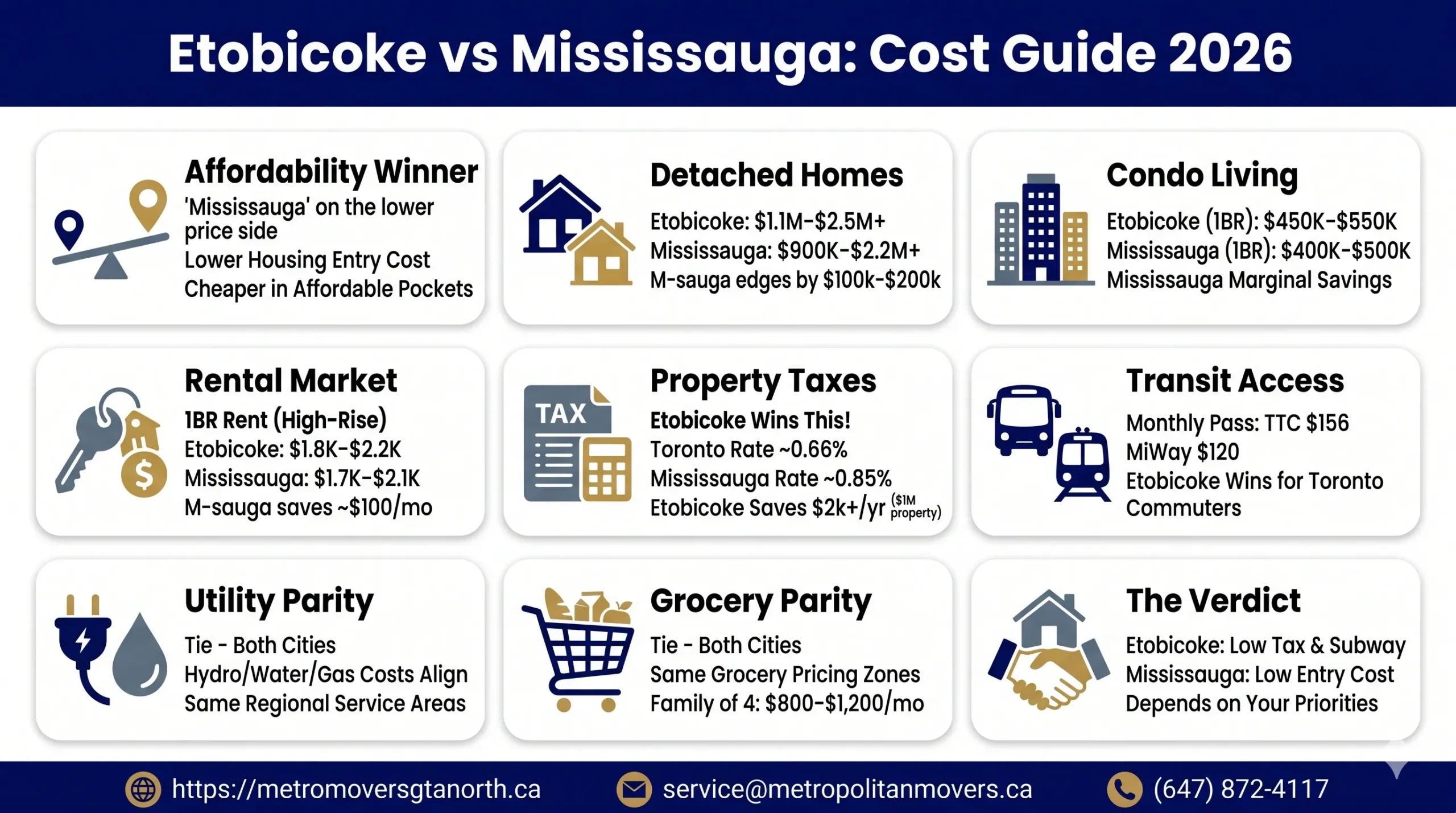
Etobicoke vs Mississauga Cost Breakdown: Housing, Taxes, Transit & Utilities
| Cost Category | Etobicoke | Mississauga | Affordability Winner |
|---|---|---|---|
| Average Detached Home Price | $1.1M–$2.5M+ (neighbourhood-dependent) | $900K–$2.2M+ (most affordable areas $100K–$200K lower) | Mississauga — lower entry cost |
| Average Condo Price (1BR) | $450K–$550K | $400K–$500K | Mississauga — marginal savings |
| 1BR Rent (High-Rise) | $1,800–$2,200/month | $1,700–$2,100/month | Mississauga — ~$100/mo savings |
| Property Tax Rate (Residential) | ~0.66% of assessed value (Toronto rate) | ~0.85% of assessed value (Mississauga rate) | Etobicoke — lower tax rate |
| Monthly Transit Pass (Adult) | $156 (TTC) | $120 (MiWay) — TTC access requires separate fare | Mississauga — if staying local; Etobicoke if commuting to Toronto |
| Hydro + Water + Gas (Monthly Avg) | $200–$300 (house) | $100–$150 (condo) | $200–$300 (house) | $100–$150 (condo) | Tie — comparable utility rates |
| Groceries (Monthly, Family of 4) | $800–$1,200 | $800–$1,200 | Tie — same regional pricing |
| Etobicoke vs Mississauga cost comparison reflects 2026 market conditions. Individual costs vary by neighbourhood, property type, and household consumption patterns. | |||
Property Taxes: Etobicoke’s Toronto Rate vs Mississauga’s Higher Mill Rate
Property taxes represent one of the most significant Etobicoke vs Mississauga cost differences — and one where Etobicoke holds a clear advantage.
Etobicoke, as part of the City of Toronto, follows Toronto’s residential property tax rate of approximately 0.66% of assessed property value annually. A home assessed at $1 million generates roughly $6,600 in annual property tax.
Mississauga’s residential property tax rate sits at approximately 0.85% of assessed value — approximately 29% higher than Toronto’s rate. The same $1 million assessed property in Mississauga generates roughly $8,500 in annual property tax — nearly $2,000 more annually than an identical-value Etobicoke property.
Over a 25-year ownership period, that $2,000 annual difference compounds to $50,000 in additional property tax payments in Mississauga compared to Etobicoke. For buyers weighing the Etobicoke vs Mississauga cost trade-off, this structural tax difference matters as much as the initial purchase price premium.
The property tax advantage makes Etobicoke more cost-competitive than housing prices alone suggest. A home that costs $100,000 more in Etobicoke than a comparable Mississauga property may deliver lower total ownership cost over a decade once property tax savings are factored in.
For detailed property tax context within Etobicoke, the Etobicoke cost of living 2026 guide breaks down tax burdens by neighbourhood alongside other cost categories.
Transit Costs and Commute Considerations: TTC vs MiWay and GO Transit
Transit costs in the Etobicoke vs Mississauga cost comparison depend entirely on where you commute. For residents who work in downtown Toronto, Etobicoke’s subway access delivers both time savings and cost efficiency. For residents who work locally or commute within the western GTA, Mississauga’s MiWay bus system offers lower monthly pass costs.
Etobicoke Transit Costs
Etobicoke residents access TTC subway service via Line 2 Bloor-Danforth at Kipling, Islington, Royal York, and Old Mill stations. A monthly TTC adult pass costs $156 and provides unlimited travel across Toronto’s subway, streetcar, and bus network. For downtown commuters, the TTC monthly pass delivers door-to-door transit at a fixed monthly cost.
Etobicoke also offers GO Transit access at Kipling, Mimico, and Long Branch stations along the Lakeshore West line, providing express service to Union Station with monthly pass costs in the $150–$200 range depending on zone.
Mississauga Transit Costs
Mississauga residents rely primarily on MiWay local bus service, which costs $120/month for an adult pass — $36/month cheaper than TTC. However, MiWay does not connect directly to downtown Toronto. Mississauga commuters traveling to Toronto must transfer to TTC or GO Transit, requiring either a separate TTC pass or GO Transit fare.
GO Transit serves Mississauga through multiple stations along the Lakeshore West and Milton lines, offering express access to downtown Toronto at monthly costs comparable to Etobicoke GO riders.
Transit Cost Verdict
For downtown Toronto commuters, Etobicoke’s subway access justifies the higher TTC pass cost through time savings and convenience. For residents working locally or commuting within Mississauga, the lower MiWay pass cost delivers savings. The Etobicoke vs Mississauga cost comparison on transit depends entirely on your employment location.
For families prioritizing transit access alongside affordability, the best neighbourhoods in Etobicoke guide maps subway and GO station proximity against housing costs.
Utilities, Groceries, and Daily Living Costs: Where the Two Cities Align
Utilities and daily living expenses show near parity in the Etobicoke vs Mississauga cost comparison. Both municipalities sit within the same regional utility service areas and grocery pricing zones, meaning hydro, water, natural gas, and food costs align closely.
Utility Costs
Hydro, water, and natural gas costs for comparable properties are nearly identical. A detached home in either municipality averages $200–$300/month in combined utilities depending on household size, consumption patterns, and heating/cooling usage. Condo residents pay $100–$150/month on average once hydro and water are separated from condo fees.
Grocery and Daily Expenses
Grocery costs follow regional pricing across the GTA. A family of four budgets approximately $800–$1,200/month for groceries regardless of whether they live in Etobicoke or Mississauga. Access to major chains (Loblaws, Metro, Sobeys, No Frills, FreshCo) is comparable across both municipalities, and discount grocery options exist in both.
Restaurant dining, entertainment, and lifestyle costs also align closely. Both municipalities offer a range of dining options from budget-friendly chains to independent restaurants, and recreational facility fees (community centres, pools, arenas) are comparable.
The Etobicoke cost of living 2026 guide provides granular monthly budget breakdowns for utilities, groceries, dining, and lifestyle expenses across Etobicoke neighbourhoods.
Neighbourhood-Level Etobicoke vs Mississauga Cost Comparison
| Comparable Neighbourhoods | Avg Detached Home Price | Transit Access | Affordability Notes |
|---|---|---|---|
| Etobicoke: Mimico vs. Mississauga: Port Credit | Mimico: $1.2M–$1.6M | Port Credit: $1.3M–$1.8M | Mimico: GO + streetcar | Port Credit: GO Transit | Mimico offers marginal savings + Toronto address; Port Credit delivers premium waterfront village character |
| Etobicoke: Long Branch vs. Mississauga: Lakeview | Long Branch: $1.1M–$1.5M | Lakeview: $1.0M–$1.4M | Long Branch: GO + TTC | Lakeview: MiWay + GO | Lakeview undercuts Long Branch by ~$100K; Long Branch offers TTC subway access via transfer |
| Etobicoke: Kingsway vs. Mississauga: Lorne Park | Kingsway: $1.8M–$2.5M+ | Lorne Park: $1.5M–$2.2M+ | Kingsway: Subway nearby | Lorne Park: Car-dependent, GO access | Both premium neighbourhoods; Kingsway commands Toronto premium + subway access; Lorne Park offers lakefront prestige |
| Etobicoke: Rexdale/Thistletown vs. Mississauga: Malton | Rexdale: $900K–$1.2M | Malton: $850K–$1.1M | Rexdale: TTC bus to subway | Malton: MiWay, near airport | Most affordable areas in either municipality; Malton edges out Rexdale by ~$50K–$100K |
| Neighbourhood-level pricing reflects 2026 market conditions. Individual street values vary significantly within each area. | |||
For families weighing these specific neighbourhood pairs, the family-friendly neighbourhoods in Etobicoke guide provides school quality, parks, and safety context alongside cost data.
Total Cost of Living: Which Municipality Wins the Etobicoke vs Mississauga Cost Battle?
The total Etobicoke vs Mississauga cost comparison depends on household priorities and trade-offs across multiple cost categories.
Mississauga Wins On:
- Lower housing entry costs — detached homes in Malton, Cooksville, and East Credit undercut comparable Etobicoke neighbourhoods by $50,000–$200,000
- Lower rental costs — marginal savings of $100–$200/month in comparable unit types
- Lower local transit costs — MiWay monthly passes cost $36/month less than TTC
Etobicoke Wins On:
- Lower property taxes — Toronto’s 0.66% rate saves approximately $2,000/year on a $1M property vs. Mississauga’s 0.85% rate
- Subway access — direct TTC subway service delivers faster downtown commutes and eliminates transfer complexity
- Toronto address benefits — easier access to Toronto services, libraries, recreation programs, and municipal infrastructure
The Verdict
For families prioritizing lowest upfront housing cost and willing to commute via GO Transit or work locally, Mississauga delivers better value. For families prioritizing subway access, lower property taxes, and Toronto address benefits, Etobicoke justifies its premium.
Over a 10–25 year ownership timeline, Etobicoke’s property tax savings narrow or eliminate the housing price premium, making the two municipalities more cost-competitive than purchase price alone suggests.
For the complete picture of Etobicoke’s cost structure, the Etobicoke cost of living 2026 guide provides neighbourhood-by-neighbourhood breakdowns across every cost category.
Moving Between Etobicoke and Mississauga: What Metropolitan Movers Etobicoke Handles
Thousands of households relocate between Etobicoke and Mississauga annually — whether upgrading from a Mississauga starter home to an Etobicoke property for subway access, or moving from Etobicoke to Mississauga to access lower housing costs and larger lot sizes. Metropolitan Movers Etobicoke has coordinated hundreds of these cross-municipal relocations, understanding the operational logistics, route planning, and timing coordination required for GTA West moves.
For families relocating from Mississauga to Etobicoke specifically, the moving to Etobicoke guide covers what to expect. For broader GTA relocations, the Mississauga moving and packing services page details operational planning for families leaving or arriving in Peel Region.
For households needing storage between addresses — if the Mississauga sale closes before the Etobicoke purchase is ready, or vice versa — moving and storage in Etobicoke keeps belongings secure until your new home is ready.
After relocating from Mississauga to Etobicoke (or the reverse), update your driver’s licence and health card address within the prescribed Ontario timeline at the ServiceOntario official address change portal.
FAQs: Etobicoke vs Mississauga Cost Comparison
Is Etobicoke or Mississauga cheaper to live in?
Mississauga offers lower housing entry costs — detached homes in neighbourhoods like Malton, Cooksville, and Lakeview undercut comparable Etobicoke areas by $50,000–$200,000. However, Etobicoke delivers lower property taxes (Toronto’s 0.66% rate vs. Mississauga’s 0.85%), which saves approximately $2,000 annually on a $1 million property. Over a long ownership timeline, Etobicoke’s tax savings narrow the gap. Renters find marginal savings in Mississauga of $100–$200/month for comparable units.
How do property taxes compare between Etobicoke and Mississauga?
Etobicoke follows Toronto’s residential property tax rate of approximately 0.66% of assessed value. Mississauga’s residential rate sits at approximately 0.85% — roughly 29% higher. On a $1 million assessed property, Etobicoke generates ~$6,600 in annual tax vs. ~$8,500 in Mississauga — a $1,900 annual difference. This structural tax advantage makes Etobicoke more cost-competitive than purchase prices alone suggest.
Which city has better transit access for downtown Toronto commuters?
Etobicoke offers direct TTC subway access via Line 2 Bloor-Danforth at Kipling, Islington, Royal York, and Old Mill stations. A $156/month TTC pass provides unlimited travel across Toronto’s full transit network. Mississauga relies on MiWay local buses ($120/month) that do not connect directly to downtown Toronto — commuters must transfer to TTC or GO Transit, requiring separate fares. For downtown commuters, Etobicoke’s subway access delivers both time savings and convenience.
Are rental costs lower in Etobicoke or Mississauga?
Rental costs are comparable with Mississauga holding a marginal edge. One-bedroom apartments in Mississauga average $1,700–$2,100/month vs. $1,800–$2,200/month in Etobicoke. Two-bedroom units range $2,100–$2,900/month in Mississauga vs. $2,200–$3,000/month in Etobicoke. Savings of $100–$200/month are typical in comparable neighbourhoods, though Etobicoke’s subway-adjacent buildings justify premium pricing for transit-dependent renters.
What are the most affordable neighbourhoods in each city?
In Mississauga, Malton, Cooksville, and areas near Mississauga Road offer the most accessible detached home pricing ($850,000–$1.2 million range). Etobicoke, Long Branch, New Toronto, and Rexdale/Thistletown deliver the lowest entry costs ($900,000–$1.3 million range). For detailed Etobicoke affordability analysis, explore cheapest places to live in Etobicoke and most affordable neighbourhood in Etobicoke.
Do utilities and groceries cost more in Etobicoke or Mississauga?
Utilities and groceries show near parity. Both municipalities sit within the same regional utility service areas (hydro, water, natural gas) and grocery pricing zones. A detached home averages $200–$300/month in utilities in either city. Grocery costs for a family of four run $800–$1,200/month regardless of location. Access to major grocery chains and discount stores is comparable across both municipalities.
How does commute time to downtown Toronto compare?
Etobicoke subway riders reach downtown Toronto (Union Station) in 25–35 minutes from Kipling or Islington stations. GO Transit from Mimico or Long Branch delivers express service in 15–25 minutes. Mississauga GO riders from Port Credit or Clarkson reach Union in 25–35 minutes, while MiWay bus-to-GO transfers extend commute time to 45–60+ minutes depending on route. For downtown commuters, Etobicoke’s subway access saves 15–30 minutes daily each way.
Does Metropolitan Movers Etobicoke handle moves between the two cities?
Yes. Metropolitan Movers Etobicoke coordinates relocations between Etobicoke and Mississauga regularly, managing route planning, timing coordination, and operational logistics for GTA West moves. Whether you are upgrading from Mississauga to Etobicoke for subway access or moving to Mississauga for affordability and larger properties, the team handles the full relocation. The moving to Etobicoke guide and Mississauga packing services cover both directions.
Etobicoke vs Mississauga Cost: The Right Choice Depends on Your Household Priorities
The Etobicoke vs Mississauga cost comparison delivers no single winner — the right choice depends on your household’s specific budget constraints, commute requirements, and lifestyle priorities. Mississauga offers lower housing entry costs and marginal rental savings, making it the stronger choice for affordability-focused buyers and renters willing to commute via GO Transit or work locally. Etobicoke delivers lower property taxes, subway access, and Toronto address benefits that justify its housing premium for downtown commuters and families prioritizing transit-oriented living.
Over a long ownership timeline, Etobicoke’s property tax savings compound to tens of thousands of dollars, narrowing or eliminating the initial purchase price gap. For renters, the $100–$200/month savings in Mississauga add up annually but may not offset the time and inconvenience of longer commutes for Toronto-based employment.
For the complete breakdown of Etobicoke’s cost structure across housing, transportation, utilities, and lifestyle expenses, the Etobicoke cost of living 2026 guide provides neighbourhood-level detail. For families prioritizing affordability within Etobicoke, the cheapest places to live in Etobicoke guide identifies the best value pockets. And for newcomers navigating both municipalities for the first time, the Etobicoke real estate for newcomers resource walks through the full decision framework.
When your housing decision is finalized and moving day approaches, Metropolitan Movers Etobicoke handles every operational detail — whether you are relocating within Etobicoke, moving from Mississauga, or arriving from another province. Explore the full services page or contact the team to begin planning.