
Finding the most affordable neighborhood in Etobicoke requires more than just scanning rental listings and hoping for a deal — it demands a neighbourhood-by-neighbourhood understanding of where genuine affordability exists, what housing types deliver the lowest monthly cost, and which pockets of Toronto’s west end offer real financial breathing room for individuals, students, families, and newcomers. Etobicoke spans an enormous geographic footprint, from waterfront condominiums along Lake Ontario where one-bedroom apartments push past $2,800 per month all the way north to post-war residential streets near Pearson Airport where basement apartments, rooms for rent, and older walk-up buildings offer some of the lowest shelter costs anywhere within Toronto’s municipal boundary. The gap between these two extremes is not marginal — it can represent thousands of dollars per year in household savings. This guide, assembled by the relocation specialists at Metropolitan Movers Etobicoke, walks through every affordable pocket of Etobicoke so you can choose a neighbourhood that aligns with your budget rather than exceeding it.
Affordability in Etobicoke is not a single number. It is a spectrum shaped by building age, unit type, transit access, neighbourhood reputation, and housing supply. A studio apartment in a modern Humber Bay Shores high-rise costs more per month than an entire two-bedroom basement apartment in Rexdale. A detached bungalow in Mount Olive-Silverstone-Jamestown can be purchased for less than a one-bedroom condo in Mimico. Understanding these dynamics — and knowing exactly where to look — is the difference between stretching your budget to the breaking point and living comfortably within it.
This resource covers every angle of affordable living in Etobicoke: market rental pricing by neighbourhood, basement apartment options, shared accommodation strategies, affordable condo buildings, social housing and subsidized programs, and complete budget breakdowns. Whether you are moving across Etobicoke to reduce your housing costs or arriving from outside the GTA entirely, the information below will help you identify the right neighbourhood before you sign a single document.
North Etobicoke: The Affordability Epicentre of Toronto’s West End
When affordability is the primary driver of your housing search, north Etobicoke is where your search should begin. The district bounded by Highway 401 to the south, Highway 427 to the west, Steeles Avenue to the north, and the Humber River to the east contains some of the lowest average housing costs within the City of Toronto — for both renters and buyers.
The housing stock in north Etobicoke is dominated by post-war construction. Many homes were developed in the 1950s and 1960s, resulting in a residential fabric of semi-detached houses, detached bungalows, stacked townhomes, and older walk-up apartment buildings set on generously sized lots. The area remains attractive for buyers looking for larger properties, direct access to highways 401, 427, and 409, and strong overall value compared to central or south Etobicoke.
The neighbourhoods within north Etobicoke that consistently deliver the lowest costs include Rexdale-Kipling, Mount Olive-Silverstone-Jamestown, Smithfield, West Humber-Clairville, Thistletown-Beaumonde Heights, Humberwood, and The Elms. Each of these areas has its own distinct character, and the following sections break down exactly what you can expect to pay in each one.
For families relocating into a north Etobicoke detached home, the wide driveways and ground-level entries make the physical move significantly simpler than navigating the elevator systems and loading dock requirements of south Etobicoke’s high-rise buildings.
Mount Olive-Silverstone-Jamestown Housing Costs: Etobicoke’s Most Accessible Entry Point
Mount Olive-Silverstone-Jamestown is, by the numbers, one of the most affordable communities not just in Etobicoke but in the entire City of Toronto. Located in the far northwest corner of the former municipality, the neighbourhood is bounded by Finch Avenue to the south, Martin Grove Road to the east, Highway 27 to the west, and Steeles Avenue to the north.
What Buyers Pay in Mount Olive-Silverstone-Jamestown
The average home in this neighbourhood sells for approximately $620,000 to $706,000, placing it near the bottom of all Toronto neighbourhood rankings by sale price. The median listing price sits around $600,000, with the full range stretching from properties listed under $400,000 to a ceiling around $1.6 million for the most premium options. Homes typically spend about 23 to 33 days on the market, with a selling-to-listing price ratio of roughly 97.5 percent — indicating measured but steady demand.
The condo market is particularly accessible. The average condo listing price is approximately $520,000, with the most affordable condos entering the market below $400,000. Townhomes average around $578,000, with entry-level options dipping below $200,000 for stacked townhome configurations. These are numbers that are virtually impossible to find elsewhere within Toronto’s municipal boundary.
The neighbourhood has experienced a notable decline in property values over the past year — a factor that is challenging for existing homeowners but represents a genuine opportunity for first-time buyers seeking an entry point into the Toronto market. Families moving into their first home in Mount Olive benefit from the neighbourhood’s detached housing stock, which accommodates full-size moving trucks and larger-volume moves without the building management coordination required by condo properties.
What Renters Pay in Mount Olive-Silverstone-Jamestown
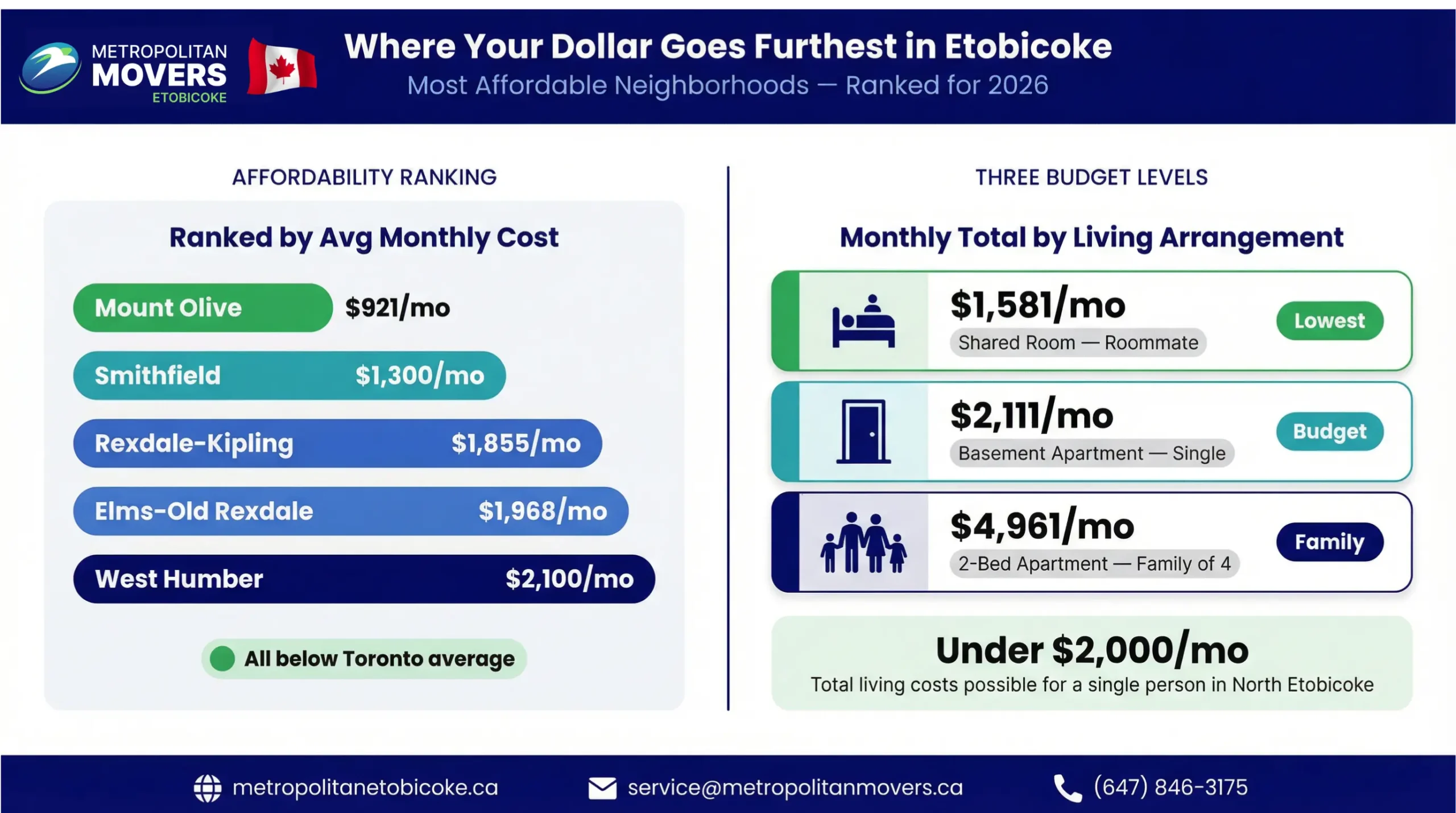
Rental pricing in Mount Olive-Silverstone-Jamestown is among the most competitive in Toronto. One-bedroom apartments currently average approximately $2,009, while two-bedroom units average roughly $2,741. Three-bedroom apartments, where available, average near $2,982. The neighbourhood’s historical average rent has been tracked at approximately $921 per month — a figure that reflects the prevalence of older, rent-controlled buildings and subsidized housing stock that anchor the community’s affordability profile.
The presence of multiple Toronto Community Housing developments and co-operative housing projects within the neighbourhood contributes significantly to the lower average figures. These units are not available on the open market but represent a meaningful share of the neighbourhood’s total housing stock.
Living in Smithfield on a Budget: Quiet Streets, Low Costs, and Airport Proximity
Smithfield occupies a quiet pocket of north Etobicoke between Kipling Avenue and Highway 427, south of Finch Avenue. It is a neighbourhood that rarely appears on “best of” lists but consistently delivers some of the most affordable living conditions in the area — precisely because it flies under the radar.
Housing Character and Pricing
The housing stock in Smithfield is predominantly low-rise residential — detached bungalows, semi-detached homes, and townhomes built in the 1950s and 1960s. Lot sizes are generous by Toronto standards, and the streetscape is quiet, residential, and notably low-density. The neighbourhood is within walking distance of Humber College’s north campus and Etobicoke General Hospital, which makes it particularly appealing to students, healthcare workers, and airport-area employees.
Private rooms for rent in Smithfield are advertised from as low as $500 to $800 per month, with shared accommodation options and furnished rooms available near the Humber College area. Basement apartments — both legal and informal — represent one of the most common rental arrangements in the neighbourhood, with one-bedroom basement units typically falling in the $1,100 to $1,500 range including utilities.
For students or newcomers arriving with limited belongings, a basic packing and moving package keeps relocation costs proportional to the modest housing prices that make Smithfield attractive in the first place.
Why Smithfield Works for Budget-Conscious Residents
Smithfield’s location near the intersection of Finch Avenue and Kipling Avenue places it within reach of TTC bus routes connecting to Kipling subway station (Line 2), the new Line 6 Finch West LRT (opened December 2025), and multiple highway on-ramps. Grocery options include No Frills and FreshCo along the Kipling-Finch corridor, and Woodbine Mall — with over 130 retail stores — is a short bus ride away. Daily needs can be met without a car, though car ownership is practical for those commuting to the airport employment zone.
West Humber Affordable Living Guide: Space, Value, and Highway Access
West Humber-Clairville is the largest neighbourhood by land area in north Etobicoke, stretching from Highway 401 in the south to Steeles Avenue in the north, with Highway 427 on the east and the Clairville Conservation Area on the western boundary. It is a neighbourhood of contrasts — large-lot detached homes on quiet residential crescents sit alongside newer townhome developments and mid-rise apartment buildings.
Rental Market and Shared Housing Options
The West Humber affordable living guide begins with understanding the neighbourhood’s unique rental structure. Purpose-built apartment inventory is limited compared to denser areas, which means much of the rental supply comes from secondary suites — basement apartments within detached homes, rooms for rent in shared houses, and secondary units in townhome complexes.
Private rooms in West Humber are advertised from approximately $850 to $1,250 per month, with many listings including utilities, internet, and laundry access. Shared accommodation is particularly common near Humber College and the Woodbine entertainment corridor, where student-oriented housing keeps per-person costs below $700 per month in some configurations. For renters on the tightest budgets, shared rooms — where two tenants split a single bedroom — can bring costs down to $500 to $600 per month.
Full basement apartments in West Humber range from approximately $1,200 to $1,700 for one-bedroom and two-bedroom configurations. These units typically offer a separate entrance, a private kitchen and bathroom, and in-suite laundry — a level of privacy and independence that is difficult to find at similar price points in central or south Etobicoke.
Home prices in the broader West Humber-Clairville area vary widely. Detached homes on premium lots can reach $2.5 million or more, while more modest properties, townhomes, and semi-detached units trade in the $600,000 to $900,000 range — still representing strong value compared to central Etobicoke neighbourhoods. If you are moving from a downtown apartment into a West Humber home, the larger volume of space means you may need to transport significantly more furniture and belongings than your previous space allowed.
What Makes West Humber Work for Families
The neighbourhood benefits from proximity to the West Humber River Recreational Trail — an 18-kilometre paved trail that extends from Humberwood Park near Pearson Airport all the way to the Clairville Conservation Area. Families have access to multiple parks, including Pine Point Park and Royal Crest Park, and the Clairville Reservoir offers a genuine nature getaway without leaving the city. Families arriving from another province find West Humber’s combination of space, affordability, and outdoor access particularly compelling — especially when the alternative is a 500-square-foot downtown apartment at twice the monthly cost.
Affordable Condo Buildings in Etobicoke North: Where Entry-Level Ownership is Still Possible
For buyers who want to own rather than rent but cannot afford the $500,000-plus entry point of south or central Etobicoke’s condo market, north Etobicoke’s condo inventory offers a genuine alternative.
The Price Landscape for North Etobicoke Condos
Condo apartments in north Etobicoke averaged approximately $448,000 in early 2026 — substantially below the south Etobicoke condo average of roughly $662,000 and even further below the downtown Toronto average. In the Mount Olive-Silverstone-Jamestown area specifically, condos start below $400,000 and average around $520,000.
Affordable condo buildings in Etobicoke North are concentrated in several clusters:
- Rowntree Road corridor (Mount Olive) — Multiple mid-rise and high-rise towers offer two-bedroom units in the $500,000 to $700,000 range, with some stacked townhome configurations available below $200,000
- Kipling Avenue corridor (Rexdale-Kipling) — Newer condo developments near the Kipling-Finch intersection offer modern units with access to the Line 6 LRT, with pricing competitive to the broader north Etobicoke average
- Humberline Drive (Humberwood) — Mid-rise condo buildings near Humber College offer one and two-bedroom units in the $400,000 to $550,000 range, with strong rental demand from the student population
The cost per square foot in north Etobicoke condos typically ranges from $500 to $800 — well below the $700 to $1,200 range that characterizes new construction across the broader Etobicoke market. For first-time buyers using Canada’s First Home Savings Account or the Home Buyers’ Plan through their RRSP, these price points bring ownership within reach.
An important consideration: condo maintenance fees in older buildings can be higher than in newer construction due to aging infrastructure and reserve fund requirements. Budget $400 to $800 per month for maintenance fees in older north Etobicoke towers, and review the building’s reserve fund study before making an offer. When the purchase closes and moving day arrives, north Etobicoke condos generally have more relaxed building management requirements than south Etobicoke towers — but confirming elevator booking and insurance requirements with the property manager before scheduling your move is still essential.
Low Budget Rental Options in Etobicoke: A Tier-by-Tier Breakdown
The most affordable neighborhoods in Etobicoke offer rental options across a wide spectrum of price points and living arrangements. Understanding the full range — from purpose-built apartments to basement suites to shared rooms — is essential for anyone working within a tight monthly budget.
Tier One: Purpose-Built Apartment Rentals (Lowest-Cost Neighbourhoods)
Purpose-built rental apartments in older buildings offer the most stable and predictable rental experience. The lowest-priced pockets for apartment rentals in Etobicoke are:
- Rexdale-Kipling: One-bedroom apartments range from approximately $1,719 to $1,956, with an average near $1,855. Two-bedroom apartments average approximately $2,684, though recent data shows significant month-over-month price declines — a signal that negotiation leverage exists for tenants.
- Elms-Old Rexdale: One-bedroom apartments range from $1,779 to $2,267, with an average near $1,968. Two-bedroom units range from $2,299 to $3,399, averaging about $2,766.
- Mount Olive-Silverstone-Jamestown: One-bedroom apartments average approximately $2,009, with the neighbourhood’s overall average rent tracked at approximately $921 — reflecting the heavy presence of subsidized and rent-controlled units.
Buildings in these neighbourhoods that were first occupied before November 15, 1991 are subject to Ontario’s annual rent increase guideline, which caps how much landlords can raise rent each year. This structural protection gives existing tenants long-term budget predictability that does not exist in newer buildings. Tenants moving between apartments in older Rexdale buildings should note that many of these structures lack elevators, making stairwell navigation a critical consideration for moving heavy furniture pieces like sectional sofas and bedroom sets.
Tier Two: Cheapest Etobicoke Basement Apartments
Basement apartments represent the single most affordable private rental option across Etobicoke. They are particularly prevalent in north Etobicoke, where homeowners with detached bungalows and semi-detached homes commonly finish their basements and rent them out as secondary suites to offset mortgage costs.
Current pricing for basement apartments in Etobicoke’s most affordable neighbourhoods:
- One-bedroom basement (Rexdale, Smithfield, West Humber): $1,100 to $1,500 per month, utilities frequently included
- Two-bedroom basement (Thistletown, Humberwood): $1,400 to $1,800 per month
- Bachelor/studio basement (near Humber College): $900 to $1,300 per month
Many cheapest Etobicoke basement apartments are advertised on community boards, local social media groups, and classified platforms rather than major rental listing websites. This means the most affordable options require active searching beyond the platforms that most people default to. The most budget-friendly listings tend to surface on neighbourhood-specific community groups and word-of-mouth referrals.
Important considerations for basement living:
- Legal compliance — Ontario requires secondary suites to meet fire code, egress, and ceiling height requirements; verify that the unit has proper permits before signing
- Utilities inclusion — Many basement rentals include hydro, gas, water, and internet in the monthly rent, which simplifies budgeting and can represent significant additional savings
- Separate entrance — Units with a separate exterior entrance offer more privacy and independence; shared-entrance configurations are typically cheaper but involve more interaction with the homeowner above
If you are moving into a basement apartment from a larger unit and need to reduce your belongings to fit a smaller space, decluttering before moving day saves both time and moving costs.
| Rental Type | Rexdale-Kipling | Mount Olive Area | Smithfield / West Humber |
|---|---|---|---|
| 1-Bed Apartment (Purpose-Built) | $1,719 – $1,956 | ~$2,009 | ~$1,800 – $2,100 |
| 2-Bed Apartment (Purpose-Built) | ~$2,684 | ~$2,741 | ~$2,400 – $2,800 |
| 1-Bed Basement Apartment | $1,100 – $1,500 | $1,100 – $1,400 | $1,100 – $1,500 |
| Private Room (Shared House) | $785 – $950 | $700 – $900 | $795 – $1,000 |
| Shared Room (Double Occupancy) | $500 – $670 | $500 – $650 | $500 – $650 |
Tier Three: Cost-Effective Shared Accommodation in Etobicoke
For students, newcomers, and anyone prioritizing maximum savings over maximum privacy, cost-effective shared accommodation in Etobicoke offers the lowest possible shelter costs within the city.
Shared accommodation is particularly concentrated in:
- Rexdale and Humberwood (near Humber College north campus) — Student-oriented rooms from $500 to $950 per month, many furnished, utilities included
- Smithfield and West Humber — Private rooms in shared houses from $795 to $1,250, with some listings including laundry and internet
- Kipling-Islington corridor — Rooms near Kipling subway station from $575 to $1,000, appealing to commuters who need rapid transit access
The shared accommodation market in Etobicoke is heavily driven by the student population at Humber College and the University of Guelph-Humber, as well as by newcomers to Canada who are establishing their initial foothold in the housing market. Many listings cater specifically to vegetarian households, female-only occupants, or students with specific lifestyle requirements — so filtering by these preferences can narrow your search efficiently.
International students and newcomers arriving with limited furniture may benefit from shipping essential household items directly to their new Etobicoke address rather than purchasing everything new locally.
Etobicoke Social Housing and Subsidized Options: What You Need to Know
For households whose income makes even north Etobicoke’s most affordable market rentals a stretch, the City of Toronto operates a Rent-Geared-to-Income (RGI) program that provides subsidized housing where tenants pay approximately 30 percent of their household income toward rent.
How the Program Works
Rent-Geared-to-Income housing is administered by the City of Toronto’s Housing Services division. Eligible applicants are placed on a Centralized Waiting List and served on a first-come, first-served basis, unless they qualify for priority access. Priority groups include survivors of domestic or family abuse, terminally ill applicants, households exiting supportive housing, applicants experiencing homelessness, applicants who are Indigenous, and youth aged 16 to 17 who head a household.
The demand for subsidized housing in Toronto far exceeds supply. The city’s most recent data shows approximately 93,000 people on the waiting list for social housing — a figure that has grown substantially over the past five years. Wait times can extend for years, and the city explicitly encourages applicants to view RGI housing as a long-term housing plan rather than a solution to immediate housing needs.
Applying for Subsidized Housing
Applications are submitted through the City of Toronto’s MyAccessToHousingTO portal. The portal allows applicants to:
- View detailed information about available buildings and units, including photos, move-in dates, and accessibility features
- Choose units of interest through a choice-based housing offer process
- Track their position and status on the waiting list
Eligibility requirements include income limits set by the province, Canadian citizenship or permanent resident status for at least one household member, no outstanding arrears to any social housing provider in Ontario, and the ability to live independently with or without support services.
Where Subsidized Housing Exists in Etobicoke
Toronto Community Housing Corporation (TCHC) operates multiple developments across Etobicoke, with significant concentrations in the Mount Olive-Silverstone-Jamestown, Rexdale-Kipling, and Thistletown-Beaumonde Heights neighbourhoods. Co-operative housing projects also exist across north and central Etobicoke, managed independently but with subsidized units administered through the city’s waiting list.
For affordable housing applicants, the city has implemented a lottery system for new buildings with more than ten units. Half of the available units are allocated through random selection, while the other half are allocated through a priority-based waitlist that rewards applicants based on how long they have been waiting.
The latest round of new affordable housing units was announced for early 2026, with the city publishing vacancies for newly constructed units as buildings reach occupancy readiness.
For households in transition between housing arrangements, secure temporary storage bridges the gap between your move-out date and your subsidized unit’s availability date — preventing the costly scramble that often accompanies uncertain timelines.
Budget-Friendly Neighbourhoods Beyond North Etobicoke: Hidden Value in Central and South
While north Etobicoke dominates the affordability conversation, pockets of relative value exist in central and south Etobicoke for residents willing to look beyond the obvious.
Alderwood: South Etobicoke’s Most Accessible Entry Point
Tucked into the southwestern corner of Etobicoke, Alderwood offers detached bungalows and two-storey homes at prices that sit below the south Etobicoke average. The neighbourhood’s housing stock is older, which keeps purchase prices more accessible than the waterfront communities to the east. Rental prices in Alderwood sit below the Mimico and Humber Bay Shores average, with three-bedroom main-floor units of bungalows advertised around $3,250 per month — expensive in absolute terms, but significantly below what comparable space costs in gentrifying waterfront communities.
The Sir Adam Beck Centre — a multi-use community hub housing a school, library, daycare, and fitness centre — provides essential family services in a single walkable location. Humber College’s Lakeshore Campus is directly adjacent, creating a student-population dynamic that keeps some rental pricing competitive. First-time renters moving into Alderwood will find the neighbourhood’s ground-level housing stock simpler to move into than the high-rise buildings that dominate south Etobicoke’s waterfront.
The Queensway: Affordable Character in Central Etobicoke
The Queensway corridor features brick bungalows from the 1940s and 1950s set on generous lots. Though property values have increased over the years, the neighbourhood remains one of the more affordable areas in south-central Etobicoke where families can still enjoy a safe residential environment. The area benefits from proximity to Sherway Gardens, IKEA, Cloverdale Mall, and the Gardiner Expressway for commuters. For anyone planning a house move into The Queensway, the wide lots and private driveways make truck access straightforward.
Islington-City Centre West: Condo Affordability Near the Subway
Islington-City Centre West is a large mixed-use district that benefits from direct subway access at Islington station. While the neighbourhood includes higher-priced housing segments, the presence of numerous older condo buildings along Bloor Street West and The Queensway creates a secondary market where resale condos are available at prices below the Etobicoke-wide average. For commuters who prioritize transit access, this area offers a compelling balance between subway proximity and relative condo affordability. If you are moving from another part of the GTA into an Islington-area condo, confirming the building’s move-in procedures — including elevator booking and insurance certificate requirements — is critical to avoiding delays on moving day.
Complete Monthly Budget: What Affordable Living in Etobicoke Actually Costs
Shelter is the largest budget line, but understanding total monthly costs requires accounting for groceries, transit, utilities, and essential personal expenses. Below is a realistic monthly budget for three household configurations living in north Etobicoke’s most affordable neighbourhoods.
| Expense Category | Single (Basement Apt) | Roommate (Shared House) | Family of 4 (2-Bed Apt) |
|---|---|---|---|
| Shelter | $1,300 | $850 | $2,684 |
| Groceries | $350 | $325 | $1,250 |
| Transportation (TTC Pass) | $156 | $156 | $312 |
| Utilities (if not included) | $0 (included) | $0 (included) | $175 |
| Internet + Mobile | $75 | $50 (shared) | $140 |
| Tenant Insurance | $30 | $25 | $50 |
| Personal + Entertainment | $200 | $175 | $350 |
| ESTIMATED MONTHLY TOTAL | $2,111 | $1,581 | $4,961 |
These numbers demonstrate that living in north Etobicoke on a genuine budget is achievable. A single person in a basement apartment with utilities included can manage total monthly expenses below $2,200. A roommate in a shared house near Humber College can live on under $1,600 per month. A family of four in a two-bedroom apartment can keep total costs below $5,000 — roughly $2,500 less per month than the same family would spend in south Etobicoke’s waterfront communities.
Strategies for Maximizing Affordability Across All of Etobicoke
Regardless of which neighbourhood you choose, several strategies consistently reduce monthly costs:
- Target buildings built before November 1991 — Ontario’s rent control guidelines cap annual increases for units in these buildings, providing long-term budget stability that post-1991 buildings cannot offer
- Negotiate during winter months — Rental competition in the GTA drops between November and February; landlords are more willing to negotiate on price, offer a free month, or include parking during this period
- Shop at discount and ethnic grocery stores — North Etobicoke’s Albion-Kipling corridor features No Frills, FreshCo, and a network of independent ethnic grocers that offer the best-value produce and proteins in the western GTA
- Use the TTC 12-Month Pass — Committing to an annual pass reduces the effective monthly cost from $156 to $143, saving $156 per year
- Take advantage of the TTC fare cap — Starting September 2026, riders who pay per trip will automatically ride free after 47 trips in a calendar month, eliminating the risk of overpaying relative to a monthly pass
- Explore co-operative housing — Etobicoke has multiple housing co-ops that offer market and subsidized rates; while many have closed their waitlists, checking directly with individual co-ops is worthwhile
- Register with Access to Housing early — The subsidized housing waitlist is long, but getting your application submitted through MyAccessToHousingTO starts the clock on your wait time
When moving between affordable units, keeping relocation costs proportional to your housing budget matters. Getting a customized moving estimate before committing to a new lease ensures that moving day does not create a financial hole that takes months to recover from.
Neighbourhood Comparison: Where Each Budget Level Finds Its Best Fit
Not every affordable neighbourhood suits every situation. Here is a quick-reference guide to match your financial profile with the right Etobicoke pocket:
- Absolute lowest monthly cost (shared room, student housing): Mount Olive-Silverstone-Jamestown or Smithfield near Humber College — shared rooms from $500/month
- Lowest private rental (basement apartment, utilities included): Rexdale-Kipling, Thistletown, or West Humber — one-bedroom basements from $1,100/month
- Most affordable condo ownership entry point: Mount Olive-Silverstone-Jamestown — condos from under $400,000; townhomes from under $200,000
- Best value for families needing space: West Humber-Clairville or Smithfield — larger lots, detached bungalows, quiet residential streets
- Most affordable area with subway access: Islington-City Centre West — resale condos near Islington station at below-average prices
- Best combination of affordability and waterfront proximity: Alderwood — lower prices than Mimico or Humber Bay Shores while remaining in south Etobicoke
- Social housing and subsidized options: Mount Olive-Silverstone-Jamestown and Rexdale-Kipling — highest concentration of TCHC and co-operative housing developments in Etobicoke
For seniors considering downsizing from a larger family home into a more affordable unit, north Etobicoke’s ground-level bungalows and accessible apartment buildings offer both cost savings and the practical benefit of single-level living. If you have a piano or other specialty items that need to accompany you to your new home, confirming the new unit’s dimensions and access points before committing prevents costly surprises.
What Moving to an Affordable Etobicoke Neighbourhood Actually Involves
Moving into a budget-friendly Etobicoke neighbourhood comes with its own set of logistics that differ from moving into premium areas.
Basement Apartment Moves
Basement apartments require careful measurement before moving day. Stairwell width, ceiling height, and doorway dimensions determine whether your existing furniture will physically fit. Professional movers experienced with basement navigation know how to angle oversized items through tight turns and low ceilings — something that self-managed moves frequently get wrong, resulting in damage to both furniture and walls.
Shared Accommodation Transitions
Moving into a shared house or a single room requires a fundamentally different approach than moving an entire household. A single room’s worth of belongings can often be handled with a smaller moving package, and packing services focused on essentials keep costs aligned with the modest scope of the move.
Older Building Considerations
Many of north Etobicoke’s most affordable apartment buildings lack elevators. Moving into a fourth or fifth-floor walk-up with heavy bedroom furniture, bookcases, and kitchen equipment requires a team with the physical capability and equipment to navigate narrow stairwells safely. Attempting this with untrained help risks injury, damage, and a move that takes three times longer than it should.
If You Are Arriving from Outside Ontario
Newcomers relocating from another province or arriving from outside Canada often need to ship freight or bulk household items ahead of their arrival. Coordinating the delivery to align with your lease start date prevents the need for temporary storage. If timing does not align perfectly, temporary secure storage keeps your belongings safe until your unit is ready.
Metropolitan Movers Etobicoke has spent over 15 years helping people move into every type of housing across Etobicoke — from high-rise condos in Humber Bay Shores to basement apartments in Rexdale to detached homes in Smithfield. We understand that moving on a budget means every dollar of the moving cost matters, and we price our services accordingly. Every quote is customized to your specific unit type, access conditions, and volume of belongings. If you are relocating from another part of Toronto or moving your office alongside your home, we handle both with the same attention to detail.
The Real Map of Affordable Living in Etobicoke: Where Budget Meets Quality of Life
The most affordable neighborhoods in Etobicoke are not hidden — they are simply overlooked by people who default to searching only the waterfront communities and central districts that dominate real estate marketing. North Etobicoke neighbourhoods like Mount Olive-Silverstone-Jamestown, Smithfield, Rexdale-Kipling, West Humber-Clairville, Thistletown, and Humberwood offer some of the lowest housing costs in the entire City of Toronto, while still providing access to transit, grocery options, parks, healthcare facilities, and the employment opportunities that the broader GTA economy provides.
The financial reality is clear: a single person can live in north Etobicoke for under $2,200 per month in total expenses when choosing a basement apartment with utilities included. A student or newcomer using shared accommodation can manage under $1,600. A family of four can keep total monthly costs below $5,000 — a figure that is functionally impossible in downtown Toronto or even in south Etobicoke’s waterfront communities.
The trade-offs are equally clear: longer commute times to the downtown core, older housing stock that may lack modern finishes, and neighbourhoods that carry reputational baggage that does not always match their current reality. For residents who prioritize financial stability over aesthetic polish — and who value space, affordability, and community over waterfront views and concierge services — north Etobicoke delivers a quality of life that is genuinely difficult to match anywhere else within Toronto’s boundaries at these price points.
And when it is time to make the move, Metropolitan Movers Etobicoke is here to ensure that the transition is handled with over 15 years of experience, transparent pricing, and the specific expertise that comes from knowing every building type, street layout, and neighbourhood across this sprawling, diverse, and deeply underestimated part of the city. Get your customized moving estimate today and take the first step toward affordable Etobicoke living.
Frequently Asked Questions About Affordable Living in Etobicoke
What are the cheapest neighborhoods to rent in Etobicoke?
The lowest-cost rental neighbourhoods in Etobicoke are concentrated in the north: Rexdale-Kipling, Mount Olive-Silverstone-Jamestown, Smithfield, West Humber-Clairville, and Thistletown-Beaumonde Heights. One-bedroom apartment rents in these areas range from approximately $1,719 to $2,009 per month, while basement apartments — the most affordable private rental option — start as low as $1,100 with utilities included. Shared rooms near Humber College can be found for $500 to $670 per month.
How much does a basement apartment cost in Etobicoke?
One-bedroom basement apartments in north Etobicoke’s most affordable neighbourhoods typically range from $1,100 to $1,500 per month, with utilities frequently included in the rent. Two-bedroom basements range from $1,400 to $1,800. Bachelor or studio basements near Humber College can be found for $900 to $1,300. Many basement listings include a separate entrance, private kitchen and bathroom, and in-suite laundry access.
Is Mount Olive-Silverstone-Jamestown a good area to buy a home?
Mount Olive-Silverstone-Jamestown offers some of the most accessible home ownership entry points in the entire City of Toronto. The average home sells for approximately $620,000 to $706,000, with condos averaging around $520,000 and some stacked townhomes available below $200,000. The neighbourhood has experienced a price decline of approximately 24 percent over the past year, which creates opportunity for first-time buyers. The area benefits from proximity to transit, grocery stores, and community services, though it sits farther from subway stations than central Etobicoke.
What is cost-effective shared accommodation like in Etobicoke?
Shared accommodation in Etobicoke is most prevalent near Humber College and along the Kipling-Finch corridor. Private rooms in shared houses range from $785 to $1,250 per month, with many including utilities, internet, and laundry. Shared rooms with double occupancy can cost $500 to $670 per month. Most shared accommodation listings cater to students, newcomers, and young professionals, and many specify preferences such as vegetarian households, female-only occupants, or no-smoking environments.
How do I apply for social housing in Etobicoke?
Applications for Rent-Geared-to-Income (RGI) housing in Toronto are submitted through the City of Toronto’s MyAccessToHousingTO online portal. Eligible applicants are placed on a Centralized Waiting List and served on a first-come, first-served basis unless they qualify for priority access. The current waiting list includes approximately 93,000 applicants, and wait times can extend for years. The program allows tenants to pay approximately 30 percent of their household income toward rent. The city also operates a lottery system for new affordable housing units.
Are there affordable condos in North Etobicoke?
North Etobicoke offers some of the most affordable condo ownership opportunities in Toronto. Condo apartments in the district averaged approximately $448,000 in early 2026, with the most affordable units in Mount Olive-Silverstone-Jamestown starting below $400,000. The Rowntree Road corridor, Kipling Avenue corridor, and Humberline Drive near Humber College all feature affordable mid-rise and high-rise condo buildings with units below the citywide average price.
Can I live in Etobicoke for under $2,000 per month total?
Yes, it is possible for a single person to live in north Etobicoke for under $2,000 per month by choosing shared accommodation (approximately $850/month), buying groceries at discount chains ($325/month), using a TTC monthly pass ($156/month), and keeping personal expenses modest. This requires sharing a house or splitting a room, shopping strategically, and minimizing discretionary spending. Basement apartments with utilities included bring total costs to approximately $2,100 to $2,200 per month.
What is the cheapest way to move within Etobicoke?
The most cost-effective approach is to declutter before moving day, use a professional moving service with transparent hourly or flat-rate pricing, and schedule your move on a weekday or during off-peak months (November through February) when demand is lower. Moves within north Etobicoke’s ground-level housing stock are typically less expensive than moves involving high-rise buildings due to simpler access conditions. Getting a customized quote based on your specific unit type, volume, and access conditions ensures you pay only for what your move actually requires.
How long is the wait for subsidized housing in Toronto?
The City of Toronto’s centralized waiting list for subsidized housing currently includes approximately 93,000 applicants. Wait times vary significantly based on unit size needed, geographic preferences, and priority status. Applicants with priority access — including survivors of domestic abuse, terminally ill applicants, applicants experiencing homelessness, and Indigenous applicants — may receive offers sooner. The city encourages all applicants to treat RGI housing as a long-term plan rather than an immediate solution.
Is North Etobicoke safe for families?
North Etobicoke’s safety profile varies by neighbourhood, and broad generalizations do not reflect the reality of individual streets and communities. Many residential pockets within Smithfield, West Humber, Humberwood, and Thistletown are quiet, family-oriented, and have low rates of property crime. Community investment, transit improvements including the new Line 6 Finch West LRT, and ongoing residential development are contributing to positive change across the district. As with any neighbourhood, visiting in person, walking the streets, and talking to current residents provides the most accurate sense of the community.
What transit options are available in North Etobicoke’s affordable areas?
North Etobicoke is served by TTC bus routes connecting to Kipling subway station on Line 2, the new Line 6 Finch West LRT (opened December 2025) connecting to Line 1 at Finch West station, and GO Transit’s Kitchener line at the Etobicoke North station. The bus network covers the major corridors including Kipling Avenue, Finch Avenue, Albion Road, and Rexdale Boulevard. Highway access to the 401, 427, and 409 is a significant advantage for car commuters and airport-area workers.